Why Older Adults Are Lousy Multitaskers

I’m a multitasker. I started today by simultaneously eating breakfast, watching CBS
This Morning, and reading an article on Pope Francis. Later, I jumped from
computer to tablet to phone. Unfortunately, whenever I multitask I miss out on
important information, skip steps, and often have to backtrack. I’m a multitasker, but not a successful one.

Multitasking. Image from www.Christmaholic.nl

Multitasking. Image from http://www.Christmaholic.nl

Part of the problem is my age. Multitasking depends on working memory, the memory system that keeps information in awareness so that it can be manipulated or worked on. We rely on working memory not only to multitask but to keep in mind what we’re doing as we complete such everyday things as cooking, cleaning, carrying on a conversation, and remembering why we just came into a room. Unfortunately, working memory declines with age. That means that as we age we can keep fewer things in mind, and often a single task fills or overflows our working memory baskets, with no room for anything else.

One study, described by Charles Q Quoi at Livescience, had younger (average age 25) and older (average age 69) adults work on a task, then interrupted them periodically. Young and old subjects paid equal attention to the interruption, but the older subjects had more difficulty in subsequently uncoupling attention from the distraction and reattaching it to the original task. We older adults can’t move readily from one task to another. Susan, who blogs at “Help! Aging Parents!”  describes how, in the midst of multitasking holiday chores, she forgot to publish her planned post. She recommends that we follow the example her 100-year-old mother-in-law, who solved her problem with disorganization by focusing on one task at a time. She also provides a helpful link to a Mayo Clinic webpage titled “Stop Multitasking and Learn to Focus.” The author Amit Sood, M.D., recommends that we do the following to improve our ability to complete tasks:

• Eliminate distractions, particularly those from electronic devices such as TV and phones.
• Schedule the tasks that require the most concentration at times when energy is highest
• Get rid of off-task mental clutter by writing down what we want to remember later
• Practice improving your focus via attention training or meditation

When I multitask, I inevitably miss elements of one or more of the tasks. I don’t mind being inefficient and having to retrace my steps when I’m doing things that aren’t urgent or important (I actually liked my morning with Nora O’Donnell, Pope Francis, and Cheerios), but get frustrated when I’m trying to perform well. In such situations, it’s time to leave the mental juggling to young adults and be a uni-tasker.

Posted in Psyche | Tagged , , , , | 2 Comments

My Midlife Crisis? Which One?

I wrote earlier about the First, Second, and Third Spiritual Journeys of life. The Second Journey—having to do with some sort of reorientation during middle adulthood—encompasses the “mid-life crisis” of common parlance. This post will describe the concept of the mid-life crisis and compare it with my progression through midlife.

I should start by admitting that I probably didn’t ever have a full-blown mid-life crisis—and it is by no means assured that any but an unlucky few have their journey buffeted by any sort of midlife gale. Some researchers think nothing different happens in midlife than in any other phase of adulthood. Still, it does seem that many people have some sort of mid-life transition, crisis or not. Studies find that happiness dips in middle adulthood, suggesting that something is going on then. Writers on matters psychological, such as this post, describe midlife turmoil as common. So, perhaps the best advice is to not be surprised if nothing much happens to you at midlife, but also not be surprised if something does.

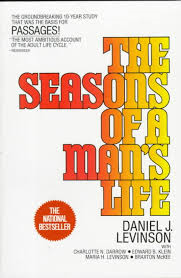
Seasons of a man's lifeYale psychologist Daniel J. Levinson was one of the main proponents of the idea that crisis is a hallmark of the transition from young adulthood to middle adulthood.  In his 1978 book The Seasons of a Man’s Life (he didn’t write about women’s psychological development until later), Levinson indicates that the settled life that most men attain by the 30s is disrupted by a period of reappraisal.  The man asks himself questions such as: “What have I done with my life?” “What is it I truly want for myself and others?” “What have I done with my early Dream and what do I want with it now?” Levinson claims that the answers to such questions are disconcerting:

“As he attempts to reappraise his life, a man discovers how much it has been based on illusions, and he is faced with the task of de-illusionment. By this expression I mean a reduction of illusions, a recognition that long-held assumptions and beliefs about self and world are not true.”

Mid-life is not the first time that we find that what once comforted us is illusory: Consider the 6-year-old who learns the truth about Santa Claus, or the 10-year-old who figures out that dad or mom isn’t the smartest/strongest/coolest parent around, or the 16-year-old who discovers that his or her nation, city, school, or social niche isn’t better than all others. Perhaps de-illusionment is a necessary part of development throughout life. The illusions lost in mid-life bring particular pain, though.

What transition did I go through in mid-life? As the title of this post suggests, I went through more than one. Here is a summary:

  • When I was 32, I decided that I wasn’t satisfied teaching about a field in which I hadn’t practiced, and sought part-time (later full-time) clinical work in state prisons.
  • After five years and three jobs in the prisons of two different states, I became dissatisfied with what I could accomplish working in correctional settings and took a job in a private hospital, which subsequently led to outpatient psychological practice.
  • In my early 40s, I felt the need for an expressive outlet, and began spending a good deal of time writing poetry, short stories, and essays.
  • After twenty years of marriage, it became evident that both my wife and I were deeply unhappy with our relationship. Efforts to mend our rift weren’t successful, and we divorced when I was 46.
  • Shortly after I turned 50, I decided I needed to teach others something of what I had learned during my career, and took a full-time job teaching undergraduates. I thus came full circle back to the classroom, the site of my first professional job.

Most of these transitions occurred over a period of time ranging from a few months to a few years. In every case I was impelled by some degree of discontent, dissatisfaction, or de-illusionment. I plan to write about a few of these changes in more detail, exploring the factors that motivated me. In the meantime, here are the main points of this post: midlife transitions can occur in a variety of ways, including, as in my case, numerous moderately large life changes over the course of decades. Don’t expect a crisis, and don’t assume that, if a crisis occurs, it will look at all like someone else’s crisis.

Posted in Psyche | Tagged , , , , , , | 2 Comments

Faithfulness in Old Age: John M. Perkins

John M. Perkins

John M. Perkins

Yesterday I attended the talk by John M Perkins during Calvin College’s January Series. I’ve known about Perkins for most of my adult life—his leaving Mississippi as a young man after his brother was killed by a town marshal, planning never to return; his conversion to Christianity; his return to Mississippi in obedience to what he perceived as God’s  call;  his work in community development; his arrest and torture for his civil rights activities in the 60s. He is now 83 years old, and I wondered what sort of old man he had become. Was he tired after years of struggle, discouraged about the prospect for improving the lot of minorities and the poor? Or is he hopeful for the future?

If his talk is any indication, Perkins is not only hopeful for the future, but is convinced that major change is now underway. He described today’s young people as “the first post-racial generation.” He told of many poor youth from Mississippi getting an education and returning to their communities, and of those from elsewhere relocating to join in ministry. Unlike many elderly adults, he lives not in the past but in the present and future. He is generative in the sense that Erik Erikson uses the term: his life is devoted not to personal aggrandizement or self-indulgence, but to helping others build communities and relationships that will flourish long after he is gone.

I was fascinated by a comment Perkins made when talking about his longing for a society free of racial prejudice. He said, “We need to empty ourselves into that longing. We’re going to empty ourselves anyway, so we might as well empty ourselves here.” The wisdom of age is to know we will inevitably empty ourselves—that our energies will pour from us until we are fully depleted. The wisdom of faith is to know that what we deliberately pour out in love will not be lost but will provide irrigation for what is good, just, and lasting.

Perkins lives a God-filled life—not just in the sense that he believes, but that he lives into what he believes. He described God as having a heart centered on love and justice, and sees God’s people as having a “ministry of reconciliation (almost certainly a reference to 2 Corinthians 5),” facilitating human reconciliation with one another and with God. Referring to Psalm 23, he said that God “has given me these 83 years, and now goodness and mercy are about to get me, and I’ll dwell in the house of the Lord forever.” What a marvelous way to frame his eventual death!

Mature Christians are thought to display the Fruits of the Spirit—characteristics of the heart that the Holy Spirit inculcates in those who faithfully follow the way of Christ. Perkins has followed Christ’s way for decades, and it seems that at this point he possesses not just stray pieces of fruit, but whole basketsful of the stuff. He bears no bitterness for the mistreatment he sustained. He says that “God’s heart is for love and justice,” and it is clear that love fills his heart as well. His ministry of reconciliation is evidence of his desire for peace, another fruit of the Spirit according to the list found in Paul’s letter to the Galatians. Then there is his joy. For Perkins, joy has come as his life’s work nears its fulfilment. Patience, kindness, goodness, faithfulness—Perkins seems imbued with each of these. I left the session thankful for the opportunity to see a living saint, one who bears witness to God’s goodness not only by his words but by his life. When growing old means, as with Perkins, growing ever further into the love and grace of God, aging becomes not something to dread but something to celebrate.

Posted in Spirit | Tagged , , , , , , , , | Leave a comment

My Sacred Journey

I recently wrote about spiritual journeys. In that context, I was interested to see a blog post on “The Quest for a Good Life” in which Andy Tix describes his life as a sacred journey. He tells a little of the story of his life, and describes the themes that he sometimes uses to interpret that story–anxious awareness of death, secular affirmation of human worth, or autonomy/achievement. He then uses Frederick Buechner’s “The Sacred Journey” to describe the theme he prefers to use as an interpretive lens, one of God-soaked grace. It’s a nice reflection on the different ways we can interpret our journeys.

Posted in Spirit | Tagged , , , | Leave a comment

Interview: Caring for an Elderly Parent

As discussed in a previous post, in 2012 39% of adults in the U.S. served as a caregiver for an elderly family member. The numbers of caregivers are expected to increase as the population ages. I sat down recently to talk to one such caregiver, Nance R. Nance lives in West Michigan and is trained in psychology and pastoral counseling. She works as a Licensed Professional Counselor at Psychology Associates of Grand Rapids. For about six years, she has also been quite involved in caring for her elderly mother. Here is how she describes the needs her mother had and how she helped meet those needs:

Bob: Can you tell me a little about the things your mom has been through and what changes you see as a result of them?

Nance: My father passed away in 1993 and my mom became a snowbird between Oregon and Arizona for a number of years. Around 2007 we noticed that she felt she could no longer do that. She decided to live year round in Oregon tapping into the Senior Center there, and I assisted with other needs long distance, flying out frequently. In 2009 she decided she needed to leave her home, stop cooking, and give up driving. We moved her to Grand Rapids. She knew she wanted to live near us. My older brother had assisted her when she was in Arizona, but my younger brother in Oregon is disabled. She thought it would be best to be near us because typically daughters tend to be more attentive. She wanted to live in a community where activities were available to do things she enjoyed and where she could meet people that were in the same stage of live with her. She moved into an independent living facility and enjoyed being able to go to Bible study, a book club, exercise classes, and having a dining room where she could go to have three meals a day.

She made a big life change and did so successfully, then. How old was she when she made the move?

She is 86 now, so she was around 82. She was willing to make new friends. In the same month she moved in, a pastor and his wife moved in across the hall and another moved in down the hall. They all got to know each other and ended up creating a table at lunch together. She had almost an instant community. The pastor and his wife kind of took her and the other woman under his wing and look after them.

So things went very well at first. I understand she’s had some difficulties, though.

She has a degenerative disease CMT, (Charco Marie Tooth named after the doctors who discovered the disease) where from her elbows down and her knees down her nerves have degenerated and they no longer fire on her muscles causing neuropathy. Because the nerves no longer fire on the muscles it is important that she walks to keep those muscles working. She knows she needs to walk, and uses a walker. She’s learned to adjust and adapt. If her strength is low, she thinks, “Well, even if I can’t walk today, I’ll walk tomorrow.” She has always maintained an adaptive attitude; she does not dwell on what she cannot do, but what she can do. Her heart issues have become more prevalent; previously, she had a heart attack when she was in Arizona. Since 2011 her heart has gone into atrial fibrillation. That tires her, so she can’t always get to Bible study or book club. She has had bouts in the hospital as the heart problems have progressed. She has type 2 diabetes that she manages with her diet. We’ve seen how all systems work together. If there’s a problem somewhere, she tends to get a urinary tract infection, which in turn puts her in congestive heart failure and she’s back in the hospital.

It sounds like she managed her medical problems pretty well for a while, but it’s becoming harder to do so.

She didn’t develop congestive heart failure symptoms until recently, and that’s definitely affected her life. We have to constantly monitor her. If her weight goes up or down she has to take extra medication. Yes, it’s become harder. The other thing that happened this year is that she fractured her back due to osteoporosis and arthritis. That debilitated her more than anything because the pain was so excruciating. She had to relearn how to get out of bed. She was put on a pain medication that she was allergic to, so for a while she wasn’t doing very well cognitively. Before the injury, she had been able to manage her own medication, but now she’s lost that ability and needs help with that. Her life now feels smaller. She used to travel with me to other states, and now she can’t do that anymore.

How have these increased medical problems affected her emotionally?

At times she accepts it well, –“I can’t get to all of my activities, but I can get to meals.” Other days she feels frustrated that she can’t get to everything.

No longer being able to travel together is one way that the relationship between the two of you has been affected. Are there other ways?

When I take her shopping, it’s harder for her to do that, we can only do it for a shorter period of time. She likes to go out to lunch, but sometimes cognitively she’s not on her game, so she doesn’t feel fully present. Before, she was enjoying the environment and enjoying the food.

I’m sure it is hard to see those changes.

She wants me to come and just be with her for a period of time. She is feeling more dependent. She no longer feels as confident talking to doctors. She wants to call me before making any decisions on her health.

So she went from being a very independent person to wanting more support. It also sounds like she really finds comfort in your presence now.

She likes it if I call at the end of my work day.  She looks forward to hearing from me on my way home.  It can be hard because I’m the only relative here to provide caregiving.  My husband and daughter are here and sometimes they can step in, fortunately.

Sometimes an issue in families can be an unequal burden in caregiving. In your case, your brothers can’t help because they aren’t nearby.

I do inform them when she’s in the hospital. They want to know every step that’s going on. She has had much more illness since she’s been here. They are there for emotional support, but are unable to come out to provide physical support.

Having moved here, she doesn’t have long-term friends there to provide support. Are the friends she has made helpful to her?

Absolutely.  The one friend, who is 98 years old, will come and knock on her door before meals to see if she’s OK and coming to eat.  No, she doesn’t have her friends from her church and community, that’s a choice she did make.  She does lean on me a lot, since she only has her friends from the facility.  She’s made lots of friends there, but she calls mostly on that original group of friends she made.  They have been helpful to notify me when she has to go to the hospital, for example.  With my busy schedule, I’m not available as much as she would like.  When I have a day off, I try to devote part of that day or the whole day to her.  I tell her, “I’ll see you on my day off” and usually she’s OK with that.

We talked about how the relationship has changed and she’s adapted. Are there other ways that your life has been changed?

I’ve felt at times that I needed to go part time at my clinical practice to manage the issues going on with my mother. There have been weeks when I have cut back. At times, taking care of her has been like a part-time job. I’ve taken days off, or I had to go in before work and after work. It’s added some things onto my plate. I have had to rearrange my schedule, or spend my weekends in the hospital. Sometimes there are have been gorgeous days and I just look outside and say to myself I’d rather be out there doing something else, than be in the hospital all day. At times, I’ve left the hospital and told the nurses that I’ll be back in the evening, I’m going to take some space and time for me. We’ve been there a lot this year, and I need some breaks!

That advice that therapists give clients to take care of themselves, you’re actually following!

Absolutely.  The one friend, who is 98 years old, will come and knock on her door before meals to see if she’s OK and coming to eat.  No, she doesn’t have her friends from her church and community, that’s a choice she did make.  She does lean on me a lot, since she only has her friends from the facility.  She’s made lots of friends there, but she calls mostly on that original group of friends she made.  They have been helpful to notify me when she has to go to the hospital, for example.  With my busy schedule, I’m not available as much as she would like.  When I have a day off, I try to devote part of that day or the whole day to her.  I tell her, “I’ll see you on my day off” and usually she’s OK with that.

Are there any words of advice that you have for families who have an older relative who was more independent, but is becoming more dependent now, of how they should approach that?

What I’ve heard from a lot of people who have been in my shoes is sometimes when it is in that cascade of events; it can be an emotional roller-coaster for that last year of life or last two years of life. You have to ready to expect to be in and out of the hospital. Not every elderly person goes through that process, but a lot do as systems start to fail. The cardiologist talked to us about the fact that if her heart shuts down her brain will, too, and she won’t come back, so we have a DNR on her. Those are the decisions you have to make. You have to prepare yourself as to how you can manage it alongside your family life and your job in a way that can take care of you. This caretaking piece is like having small children; it takes that degree of energy. We’ve been fortunate. My mom has had moments when she’s been down, but we’ve been able to work through that. The situation is different from that of my mother-in-law, for example, who has been very reluctant to give up her car and she got in an accident. Just be aware that it will take an energy level that you may not realize beforehand. Be prepared for that.

Thanks so much.

Postscript: Less than three weeks after this conversation, I received word that Nance’s mother had died, so Nance has gone from the role of caregiver to that of grieving daughter. Like so many others, Nance took on the task of assisting her mother through her last years of life, and did all she could right to the end.

Posted in caregiving | Tagged , , , , , , | Leave a comment

Spiritual Journeys

Soul SearchersSoul Searchers: An Anthology of Spiritual Journeys (Eerdmans, 2002), complied by freelance editor Teresa de Bertodano, is a collection of biographical, autobiographical or fictional accounts of life events that convey something of who each person was or was called to be. Life is often described metaphorically as a journey, and de Bertodano adopts this convention.

Though each person’s journey is all of one piece, it can also be thought of as divided into segments. I think that de Bertodano’s way of dividing the journey—an approach that she attributes to Gerald O’Collins’ Second Journey–to be particularly useful. The
first segment—the First Journey—occurs during childhood and youth, and includes
seeking one’s place in the world and achieving a sense of identity. At the end
of the first journey, the person has entered adulthood. The Second Journey
entails a change of direction somewhere midway between young adulthood and
elderhood. The person typically encounters some obstacle in the path—in the
words of Richard Rohr, there is some sort of falling, some failure or
disappointment. This may lead to a totally new direction, or to a different
understanding of the path that one is on. The Third Journey occurs near the end
of life—whether that end is sensed in youth or the fullness of years—and
prepares the person for death.  De Bertodano notes, “the Third Journey is the only one we can be sure of completing.” We may never acquire a core identity or the greater maturity that comes with the Second Journey. We will, though, all take the last journey to the grave.

This blog is devoted to the second half of life—to the Second and Third Journeys. Just to give some sense of the stories about these journeys De Bertodano included in her anthology, here are some examples that I was already familiar with and you may be as well. The Second Journey section included stories from the lives of Moses, St. Paul, St. Ignatius Loyola, John Wesley, Thomas Merton, and Charles Colson. Among the stories in the Third Journey section were the deaths of Abraham and Sarah, St. Thomas More awaiting martyrdom, Fyodor Dostoevsky’s near execution, and Dietrich Bonhoeffer in the concentration camp. Though the focus of the anthology is on spiritual journeys, most of the selections were journeys of the psyche as well.

I have written previously about life stories. For me, and I suspect for many others, the First and Second Journeys compromise much of what is most central to my life story at this point (I’m not far enough into the Third Journey for it to be included in that story). Reading the first two sections of de Bertordano’s anthology is helping me understand my own First and Second Journeys, and the third section is informing me about the journey that still awaits me. I recommend de Bertodano’s book (unfortunately it is out of print and has to be obtained from a used book seller) for those interested in life review.

Posted in Death, Psyche, Resources, Spirit | Tagged , , , , , , , | Leave a comment

A Five-Sentence Life Story

I wrote recently about the benefits of life review. Since I left full-time work in the summer of 2012, I have been thinking more about my past, that that seems to be leading to a time of life review for me. I recently read Remembering Your Story: Creating Your Own Spiritual Autobiography by Richard L. Morgan, and that has stimulated quite a bit of thought about the various stories of my life, how they combine to make a larger life story, and how that story connects with the grand story of God’s work in the world.

One of the exercises that Morgan gives is to “Write the story of your life in five short, concise sentences.” Here’s what I wrote (I didn’t manage conciseness, but no matter):

Brought up in a home of love and faith, I struggled to find myself and God. Having achieved some success at this, I married, became a father, and entered my chosen career in psychology. Through neglect and conflict, my wife and I destroyed our marriage. Chastened, I received support from friendship and a faith more aware of shortcomings. I found my voice anew in writing, teaching, and mentoring.

Having a five-sentence limit was helpful in focusing me on the essential elements of my story. The story doesn’t yet include the time since I left my job at Methodist University, largely because that narrative is still being formed (by me, by others, and most importantly by God). I encourage any of you who are interested in life review to write your own five-sentence life story. If you would like your five-sentence story posted on this blog, send it to me at bobritzema@hotmail.com.

Kent Hall, Kent State University--where I studied psychology.

Kent Hall, Kent State University–where I studied psychology.

Posted in Psyche, Spirit | Tagged , , , , , , , | Leave a comment

On Being Old Enough to Have a Stress-Free Christmas

Lynne Hybels, who ministers on behalf of third-world communities and is married to megachurch pastor Bill Hybels, recently wrote an article for the her.meneutics site at Christianity Today describing the progressively more laid-back, less frantic approach she has taken to Christmas over the course of several years. She buys fewer gifts, decorates only minimally, and no longer sends Christmas cards. This year, she decided to eliminate the huge party she used to give every December 23rd. Though the party was a lot of work, she writes that it always seemed worth having—until it didn’t. She and her husband finally decided that “we might serve our friends better by giving them a December night off rather than another party to attend.”

Lynne Hybels

Lynne Hybels

Lynne mentions age as a factor in the change she’s undergone:

“Here’s the main difference between me at 29 and me at 59: I used to think that everything mattered. Now I realize that very little matters.”

As we age, our priorities change. Perhaps much of what makes Christmas frantic has to do either with desiring to please others or with comparing ourselves to those around us and thinking we should do what they are doing. By midlife, though, both people-pleasing and social comparison start to lose importance. They used to matter a good deal, but now don’t matter very much at all.

I’ve never tried to do a lot at Christmas, so as I get older I’m not so much eliminating activities as being more thoughtful about the particular things I choose to do. Sometimes that means doing more, such as baking several kinds of Christmas cookies last year, and sometimes it means doing less, such as eliminating Christmas lights last year and this. I try to choose based on what I think will bring the most blessings to me and those I care about.

I like Lynne’s description of how she now tries to approach to Christmas: “nurturing internal peace so I can be a peacemaker, living with a depth of joy that spills joy onto others, and experiencing the fullness of God’s love so I can love freely.” Valuing such internal qualities over external glitz seems to me a mark of maturity. My Christmas wish for the readers of this blog is that you may be able to identify what matters most about the season and let go of the rest.

OLYMPUS DIGITAL CAMERA

Posted in Culture, Psyche, Spirit | Tagged , , , , , , , , | Leave a comment

Hi, I’m Bob and I’m Redeployed

Recently, as part of a series of posts about leisure and retirement, I relayed that today’s older adults are less likely than those in the previous generation or two to quit working entirely, and those who do quit working or switch to part-time employment are less interested in using the time thus freed up to pursue pleasure and more interested in pursuing significance. Given that most older adults plan to keep on doing something productive or meaningful, should we even call their status “retirement” anymore? As I noted in another post, the Free Online Dictionary defines “retire” as “to withdraw, as for rest or seclusion,” and most of us don’t seem to be planning such a retreat from the realm of active engagement. I asked “what should we call the change in activities that many older adults make after years or decades of full-time work in a particular occupation? If ‘retirement’ is a misnomer, what term is a better fit?”

A month after my retirement reception--what am I now?

A month after my retirement reception–what am I now?

This question has a personal dimension: I don’t really know what to call myself. I left my full-time job as a professor at Methodist University at the end of the 2011-2012 school year. I was given a retirement reception and received a retirement gift. I have no plans to ever take another full-time job. Yet I don’t consider myself retired, and don’t think the compromise term “semi-retired” describes my status very accurately. Why not? Well, I remain active in my profession of psychology, seeing clients an average of 10-12 hours a week and providing supervision. I write most days with the intent of making much of what I produce publicly available. I also spend a good deal of time helping my elderly parents. I haven’t withdrawn from the world of activity, and don’t expect to do so anytime soon. If I have more “rest or seclusion” than I did before I left Methodist, it is only marginally so.

One of the secondary definitions of “retire” is “To fall back or retreat, as from battle.” Thus, troops who are in an unfavorable position may pull back out of the line of fire or leave the battlefield entirely. Like many working or non-working older adults, my troops—my energies and abilities—may not be engaged in the same way they once were, but they haven’t been withdrawn entirely from the field of endeavor. Instead, they’ve been redeployed to other positions. In my case, these positions are working part-time, meeting family responsibilities, and writing. Since I can’t give a succinct answer when asked whether I’m retired, perhaps what I could say is that I’m redeployed but not retired. I like that as a way of stating that I’m no longer in a full-time job but still am more focused on productive activity than on rest.

Posted in Culture, Psyche | Tagged , , , , , , , | Leave a comment

Life Review

Gaea Yudron

Gaea Yudron

A while ago, there was an interesting post on the Changing Aging blog on the topic of memoir and life review.  The author, Gaea Yudron, the director of Sage’s Play, an organization that promotes successful aging, wrote. “As we grow older, we feel an ever-stronger need to understand and integrate the meaning and lessons of our lives.”  She cites gerontologist Robert Butler, who 50 years ago proposed that growing awareness of one’s mortality late in life prompts a life review—a process of recalling and seeking to integrate past experiences and conflicts.  I like the quote she takes from Butler:  “Only in old age with the proximity of death can one truly experience a personal sense of the entire life cycle. That makes old age a unique stage of life and makes the review of life at that time equally unique.”  In other words, only when the future has been foreshortened are we able to make sense of the whole of the lives we have lived.

As a therapist who works with younger adults, older adults, and seniors, I find that adults of all ages think about the past.  The older adults I work with are more likely to spontaneously bring up events that occurred earlier in life, though.  They also think differently about the past.  Younger adults are more likely to be looking for past experiences that may have shaped characteristics they see in themselves.  They’re searching for answers to questions such as, what in my life history made me mistrust men?  What made me want to rescue everyone?  Older adults often are seeking to answer a broader question: how did I become the person I am?  There is often greater appreciation of the uniqueness of their life circumstances, and thus greater appreciation of their own uniqueness.

I think of my work with a 66-year-old man who has been disabled for about 10 years and before that moved from one low-paying, low-skilled job to another.  As a teenager, he excelled academically and earned a university scholarship.  He subsequently received graduate training in the medical field.  He and everyone else viewed him as a success.  However, he only practiced his profession for a few years before leaving it to ramble across the country, taking whatever work he could find to support himself.  When he became disabled, he returned to the town where he grew up and now lives in a small apartment there.  He came to therapy not so much to change his life as to understand what had happened to him.  How had he lived a life different from what he expected and become the person he now is?  Had he chosen his course in life or been driven by forces he didn’t understand?  After months of life review, he has a clearer picture of what happened.  Along with this, he has achieved greater self-acceptance.  He’s decided that, although he may not look successful in the eyes of the world, he lived a life that made sense given his make-up and the challenges he encountered.

Not only can my clients benefit from exploring their pasts; I can, too.  I have been thinking especially about my faith journey.  I expect that I’ll eventually write about some of that journey on the blog.  For now, I encourage readers who are past mid-life to join with me in sifting the soil of memory, extracting the gold of greater self-knowledge.

Posted in Psyche | Tagged , , , , , , | Leave a comment