Could You Be Happy With ALS?

Nancy Perry Graham of AARP wrote a few months ago about sustaining happiness in middle and late adulthood.  She asked three middle-aged or elderly friends who were clearly happy with life what each though was responsible for their positive mood.  As she notes, a charmed life is not necessary for such well-being, since one of the three had been diagnosed in the past year with amyotrophic lateral sclerosis (ALS), also called Lou Gehrig’s disease.  I was particularly interested in that person’s story.  He is John Curran, age 59, a news director for Bloomberg, and remained happy even after receiving the diagnosis.  He told Graham that, in the 7 months since being diagnosed, he has been sustained by a loving family, a supportive church, faith in the afterlife, and good health insurance.  He added the following:

“At its core, my happiness rests on a spiritual life, a sense of purpose and — oh, yes — a sense of humor. In this life, where beauty fades, wealth wreaks more havoc than happiness and death awaits us all, if you can’t laugh about the journey’s ups and downs, you’ll fret. And who wants to worry?”

It is wonderful that Mr. Curran has both ample support in this life and faith for the next.  I’m impressed by his equanimity.   He may not be far along in the progression of the disease, though; how might he be affected when he becomes unable to dress and feed himself?  Do even persons of deep faith become despondent at that point?

Ed Dobson.  Photo: Mlive

Ed Dobson. Photo: Mlive

I found information pertinent to that question by reading about another person of faith who has ALS, namely Ed Dobson, former pastor of Calvary Church in Grand Rapids, Michigan (which is the church that my brother attends).  Dobson was diagnosed with ALS a dozen years ago, and he is now quite disabled by it.  As reported by Charley Horney in The Grand Rapids Press, Dobson admits that “waiting on the Lord can be a challenge.”  He adds, though, “But this one thing I know: God has brought me this far. . . The God who brought me this far will deal with today and tomorrow. So I can rest in his coming into my life to rearrange my furniture.”

Besides maintaining a strong faith, Dobson is comforted by positive consequences of his suffering.  In a brief 2012 article in Christianity Today, Dobson wrote: “I would exchange all the life lessons and opportunities to be healthy again.”  Nonetheless, he believes that “my ALS has been used by God to accomplish wonderful things for the kingdom, where even the worst suffering opened the doors to a new heavens and earth.”  Maybe he isn’t as happy as he might have been without ALS, but he believes strongly that God has used the disease to advance the heavenly kingdom.  Dobson sees his life as having a purpose, and if anything ALS has heightened, not detracted from, his sense of purpose.

Would my faith withstand receiving a serious medical diagnosis?  Would I have anything like the serenity that Curran and Dobson both seem to have?  It hasn’t happened to me, so I don’t know.  It’s nice to realize that even the worst medical prognosis doesn’t have to lead to misery and despair, though.   Curran and Dobson serve as reminders of how essential faith and family are when going through the valley of the shadow of death.

Posted in Psyche, Spirit | Tagged , , , , , , | Leave a comment

In case you’re wondering if you live on ….

This is a beautiful post from Lynn at her blog “All These Days That Came and Went” about how her mother influenced her and continues to do so many years after her death.  As she points out, when we look at our aging selves we see our parents manifest in us.  In the process, we become a tribute to them.

lynnmorstead's avatarAll those days that came and went ...

Beautiful GardenDear Mom,
In case you’re wondering how, or even if, you live on in our lives — I wanted to reassure you that the seeds you so carefully sowed all those many years ago are thriving and even propagating strong new shoots. The careful preparation of the soil, the tending of that young garden, the hallmarks of your special touch are still evident today.

I see your face in the mirror and realize it’s me. I see your fingers on this keyboard and see the same characteristic marks of your hard-working hands. I welcome home my college student with the same joy and urges to feed him and spoil him — just like you did for me. An inexplicable irritableness can sometimes intervene in the simplest dealings with teen-somethings — remember those turbulent waters?

I hear your voice coming out of my mouth when I sing, and laugh at…

View original post 186 more words

Posted in Psyche, Relationships | Tagged , , , | 2 Comments

“Wish I’d Had the Courage to Live a Life True to Myself”

Bronnie Ware

Bronnie Ware

Bronnie Ware, a nurse who for years gave palliative care for terminally ill adults, has described the top five regrets that her patients expressed.  I wrote earlier about the regrets of older adults, so I was interested in the items on her list. They were as follows:

1. I wish I’d had the courage to live a life true to myself, not the life others expected of me.

2. I wish I didn’t work so hard.

3. I wish I’d had the courage to express my feelings.

4. I wish I had stayed in touch with my friends.

5. I wish that I had let myself be happier.

This post will focus on the first of these—not having lived a life true to oneself—which was the most common regret.

As a psychologist, I have worked with lots of clients who were living the life that someone else thought they should live.  Usually it was a parent who had provided the blueprint they were trying to follow; sometimes it was a spouse or mentor.   Most of these clients did actually think that they should live their own life and forget about pleasing others, but found that hard to do.  They feared disappointing the advice-giver, or feared the advice-giver’s warnings would prove accurate.

  • Mom told Katherine (a pseudonym), now 38 years old, that she would make a terrible parent.  Katherine always yearned to have a child and fears that she and her husband will soon lose that opportunity.  But what if her mom is right?
  • Dad said that Kyle should give up his plan to teach, saying that Kyle wouldn’t be satisfied living on a teacher’s salary.   Kyle was excited by the idea of shaping young minds and bored by the family business, where his dad wanted him.  Kyle trusted his dad, though, and ended up joining the business.

In order to live a life true to myself, I need to know who I am.  Finding myself is complicated not only by the messages given by significant others but by those provided by our culture, which values assertion, achievement, and material accumulation.  Ignoring these influences and discovering oneself is a journey of vocation, something Brian Mahan describes as “a kind of inner consonance between our deepest desires and hopes and our unique gifts, as they are summoned forth by the needs of others and realized in response to that summons.”  (I’ve discussed Mahan’s views here.)   It is a spiritual journey, for I know myself only in relation to what is greater than myself, especially in relation to God, my creator.

I suspect that many of the older adults who believed they had been untrue to themselves had little self-knowledge when they made the decisions that shaped their lives.  Years later, they knew themselves better and recognized the discrepancy between the life they lived and the life in which they would have flourished.

Something I often emphasize with my clients is that, even if they made poor decisions in the past, they still can use what they learn to live more authentically in the present.  Self-discovery is a lifelong process, so changes made now can lead to further reflection, more insight, additional changes, and so on.

In her blog simplylifelessons, Susan Henshaw, who is currently in her late 50s, describes this sort of self-discovery.  Here is an excerpt from a recent post:

“A few months ago, it got back to me that someone I admired said I was ‘too intense’. This bothered me for so long. I guess it still does, but it is true. I am intense. I take life and most of what I do seriously. This is probably temporary after recovering from going through a difficult divorce and losing both parents in the past three years, and I will try to lighten up, but, there comes a point when acceptance plays its hand, and I must say, ‘This is me, good or bad.’”

Knowing and accepting who we are is the first step toward living a life true to ourselves.

Posted in Psyche, Spirit | Tagged , , , , , , , , | Leave a comment

Depression in Older Adults: Treatment

This is the last of a series of posts about depression in older adults.  The first post was on symptoms; the next two (here and here) were on causes.  This post is about treatment.

Since depression in the elderly may be difficult to distinguish from a variety of other conditions, it is important to obtain an evaluation from a professional who is experienced in assessing mental health problems in the elderly.  Many physicians who work with older adults have the expertise to make such an assessment, as do many psychiatrists, psychologists, or clinical social workers.  The provider’s specialty is usually not as important as their experience with emotional problems in the elderly.  Once a diagnosis of depression has been made, treatment typically involves medication, psychotherapy, or both.

prozac10c

There are a variety of antidepressant medications that can be used in the elderly; for the most part, the same antidepressants that are effective in younger adults are effective in older adults.  Older adults are often more sensitive to medications, though, so often the dosage must be lower to start.  There also is an increased risk of side effects and, since many older adults are already taking other medications, of drug interactions.  Thus, drug treatment may be more complex and take longer than is typical with younger adults.

Psychotherapy consists of a series of conversations with a trained mental health professional, usually a psychologist, clinical social worker, or licensed professional counselor.  These conversations differ in format and focus depending on the theoretical orientation of the professional, but, in general, they entail an exploration of current and past problems; an explanation for why depressive symptoms have developed; new learning about one’s emotions, thoughts, or psychic makeup; and development of skills to handle one’s difficulties.  It’s important for the client and therapist to relate well to one another and to agree on the approach being used, so a change of therapists may be advisable if these factors seem absent in the first handful of sessions.  There are a multitude of therapeutic orientations, and most of these have research data to support their effectiveness.  A few approaches that seem particularly well-suited for treatment of depressed older adults are:

  • Reminiscence-based approaches, in which the therapist leads the client in a guided life review
  • Cognitive Therapy (or Cognitive-Behavioral Therapy), which focuses on the person’s habitual self-talk and associated underlying beliefs, and
  • Interpersonal Psychotherapy, a time-limited approach that identifies and works on an interpersonal issue that is problematic for the person

Despite the fact that treatment is usually effective, many depressed older adults never seek professional assistance.  It doesn’t need to be that way!  There are competent and caring professionals available to provide medication management or therapy.  Help is just a phone call away.

Posted in Psyche | Tagged , , , , , | Leave a comment

Older Adults Month

May is Older Adults Month, per government proclamation.  This is a tradition; the site for the federal Administration on Aging states that “Every year since 1963, May has been a month to appreciate and celebrate the vitality and aspirations of older adults and their contributions to our communities.”  President John F. Kennedy first proclaimed “Senior Citizen’s Month” following a meeting with representatives of the National Council on Senior Citizens.  The name was changed to “Older Adults Month” in 1980.

older adults month

There is a theme for each year’s Older Adults Month.  This year’s theme is “Unleash the Power of Age.”  Frankly, I’m underwhelmed and a bit puzzled by the phrase.  Does age itself have power, or do the aged?  If the reference is to the power of aging itself, does that refer to free radical damage, decreased vital capacity, telomere shortening, and the like?  Are those things we want to celebrate?  I’m equally nonplussed by the “power” part of the phrase.  Are we to think of power as the political power of the aged, as evidenced by AARP’s defense of benefits for seniors that contribute to the unsustainable budget deficits we currently face?  Are we to think of the Gray Panthers, the progressive activist group founded in 1970 that not only opposes ageism but also fights for a variety of peace and justice issues?

Gray Panthers Demonstration, 1979.  Picture--PBS/Independent Lens

Gray Panthers Demonstration, 1979. Picture–PBS/Independent Lens

I wouldn’t mind learning more about them, but I suspect that’s not what the AOA has in mind.    I don’t really know what to make of this theme.  I think I prefer last year’s theme: Never too Old to Play.

Posted in Culture, Resources | Tagged , , , | Leave a comment

John Paul II on Contributions of the Elderly: Wisdom and Story

John Paul II.  Credit--Google Images.

John Paul II. Credit–Google Images.

In 1999, Pope John Paul II wrote a letter which he addressed “To my elderly brothers and sisters!”  In it he reviewed Biblical passages pertinent to the elderly, reflected on the role of the elderly in society, and provided pastoral guidance to both older and younger adults concerning the problems of the elderly.  Here’s a paragraph that is particularly rich:

“Elderly people help us to see human affairs with greater wisdom, because life’s vicissitudes have brought them knowledge and maturity. They are the guardians of our collective memory, and thus the privileged interpreters of that body of ideals and common values which support and guide life in society. To exclude the elderly is in a sense to deny the past, in which the present is firmly rooted, in the name of a modernity without memory. Precisely because of their mature experience, the elderly are able to offer young people precious advice and guidance.”

It’s common to attribute wisdom to older adults; what I find interesting is that John Paul identified the source of such wisdom as life’s vicissitudes.  The people who have had sudden changes in fortune—who have seen sure success turn to devastating failure, or who have had a sudden windfall just when things looked the bleakest—acquire a perspective unlike that of those fortune hasn’t varied.  They appreciate the fragility of human accomplishments and are modest in their expectations about how matters will come to an end.  Marilyn McIntire tells of the rabbi who, when a member of his congregation was happy about some event, asked, “How do you know it’s not a disaster?”  When a congregant was despondent, he asked, “How do you know it’s not a blessing?”  Only someone who has often tasted of life’s vicissitudes would have such questions.

Dad in Uniform, Memorial Day, 2009

Dad in Uniform, Memorial Day, 2009

John Paul’s description of the elderly as guardians of our collective memory is also apt.  For many years, my father, who served in World War II, spoke to elementary school students on Veteran’s Day.  He would put on what he still had of his uniform—he could no longer button the jacket, but no matter—and gathered pictures his buddy, a military photographer, had taken.  He hadn’t seen combat—he was a supply sergeant—but was close enough to the fighting to be able to give a first-hand account of the devastation that occurred.  Children were invariably transfixed.  Often, the children sent letters of appreciation expressing dawning awareness of what the war was like.  What was important, of course, was not that they learned a little history but that they experienced a living connection to that history.  To be taught facts about a war is one thing; to have a participant stand before you and tell what that war was like is something else entirely.

A mature perspective on life’s vicissitudes and living memories of the events which have shaped us—both of these are tremendous gifts to younger generations.  Having as we do a large contingent of elderly adults, our society is richly blessed with wisdom and story—if only we take the time to sit and listen.

Posted in Culture, Psyche | Tagged , , , , , , | Leave a comment

On the Superfluity of Electric Power, the Internet, and Other Newfangled Inventions

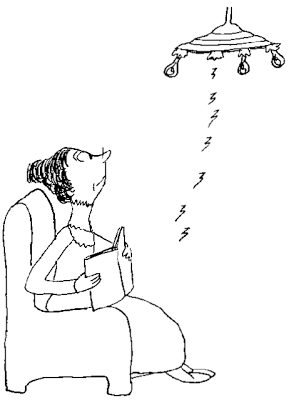
Thurber's Grandmother

Thurber’s Grandmother

James Thurber, in My Life and Hard Times, described his grandmother’s suspicions of electricity, at the time a new and mysterious technology.  She “lived the latter years of her life in the horrible suspicion that electricity was dripping invisibly all over the house. It leaked, she contended, out of empty sockets if the wall switch had been left on. She would go around screwing in bulbs, and if they lighted up she would hastily and fearfully turn off the wall switch and go back to her Pearson’s or Everybody’s, happy in the satisfaction that she had stopped not only a costly but a dangerous leakage. Nothing could ever clear this up for her.”

I thought of Thurber’s grandmother when I read about how slow older adults have been to get online. The Pew Research Centers Internet and American Life Project reports that in 2012, the percentage of adults over age 65 using the internet exceeded 50% for the first time.  However, as Paula Span notes at The New Old Age blog, the increase may have been largely because quite a few earlier adopters in the next younger age cohort had aged into the over 65 group.  Among those over 77, only a third are online.

Span cites complaints by Laurie Orlov, a tech industry analyst, about the lack of “a national effort to get 100 percent of seniors online.”    I wonder how successful such an effort would be, though.  About five years ago, my brother-in-law decided to help my parents, then in their early 80s, get online.  He set up a computer in their basement, hooked it up to the internet, and tried to teach them to use it.  They never did.

Perhaps there comes a point in our lives—a point determined by mental set, need, and circumstance more than by age—when we become wary about new technologies.  We may see them as dangerous, as did Thurber’s grandmother.  We may think of them as a world apart, one that can be entered only by means of mysterious and arcane incantations.  Or we may just see no point to them.  My mother states she got along fine without the internet all of her life, so she doesn’t see why she needs it now.   She gets irritated when she receives instructions to pay for trash pickup online or the library refers her questions to their website.  She knows, though, that if she hangs on the phone long enough, she will eventually get help from an actual person, so that’s what she does.

Almost 65, I’m comfortable with computers, the internet, and social media.  I don’t text, though, and I don’t tweet.  I’ve gotten along fine without them to this point, so why change?   Yes, I know.  I’m becoming my mother.  I’m OK with that.


Posted in Culture, Psyche | Tagged , , , , , | Leave a comment

Depression in Older Adults: The Role of Stress

OLYMPUS DIGITAL CAMERA

I’ve been writing about the nature and causes of depression in older adults.  I posted earlier about the role of genetic predispositions and past experiences in producing depression in the elderly.  Current stressors also play a role, and that will be the topic of this post.  Stress entails demands; the person’s resources are taxed as they attempt to satisfy those demands.  For example, when I took a job 11 years ago teaching college, I was stressed by the demands of preparing lessons, giving lectures, grading assignments, and advising students, all tasks that I hadn’t been faced with for over 20 years.  Fortunately, I was able to meet these demands, and the stress abated.  There are many forms of stress, of course, and some are particularly associated with an increased risk of depression.  Among these, stresses that often occur in late adulthood include:

  • Medical problems.  The risk of depression is elevated in those with chronic health problems, especially those that result in disability.  In particular, there is an increased risk of depression associated with cardiovascular disease, stroke, diabetes, and chronic pain.  Also, some medications can cause depression.
  • Losses.  The most damaging loss is that of a spouse, but losses of close friends and family members can also be quite troubling.  Most grieving older adults are sad but not depressed; nonetheless, some do develop a full-fledged depressive disorder.   Other losses that can have a significant impact on an older adult’s mood can include loss of one’s career, of status in the community, or of ability to perform valued activities.  These factors can in turn produce—
  • Powerlessness.  A major reason that depression rates are elevated in nursing homes is that many decisions are made for residents and they have little control over their lives.  Powerlessness is particularly stressful for those who had the greatest degree of power earlier in adulthood.  White males are particularly likely to be affected; their loss of power contributes to a higher suicide risk for this group.
  • Loneliness/isolation.  Here are the words of Steve, age 91 and living in a nursing home, as  reported in the Marin Independent Journal:  “Once we were very handsome and were chasing the girls away. Now no one seems interested in us except our caregivers, and that gets old, too. . . . My mind is spry and alert, but my body is decrepit. I get lonely often. Sometimes I even call my health-care provider and make up an excuse about my health so that I have the nurse to talk to.”  As friends die off and mobility decreases, many of the oldest old spend their days sitting and waiting in vain for someone to visit.  It’s not surprising that such isolation can lead to depression.

Whatever factor or combination of factors has caused a disturbance in mood, it’s advisable to seek treatment.  Next, I’ll post about medication and psychotherapy, the two most commonly used forms of treatment for depression.

Posted in Psyche | 1 Comment

Should We Become Elderly or Just Grow Old?

The term “elderly” has fallen on hard times.  A recent NPR segment by Linton Weeks reports that listeners objected to an NPR story that described a 71 year-old midwife as elderly.  One listener wrote “I was 70 in Feb and I certainly do not feel elderly …“   Another stated that the midwife couldn’t be elderly if she was still delivering babies.  Weeks concluded that the word “is becoming politically (and politely) incorrect.”

William H. Thomas

William H. Thomas

What does it mean to be elderly?  William H. Thomas, a physician who has written quite a bit about older adulthood, suggests that adults prioritize doing over being, whereas elders emphasize being rather than doing.  He thinks members of our society try to cling to adulthood and view elderhood as a decline from the supposedly higher plane of adulthood’s unending accomplishment.  In contrast to society’s denigration of the elderly, Thomas sees elders as having valuable gifts to offer the rest of society and thinks of elderhood as a different but not lesser way of living:

“Elders develop a new relationship with time.  As the years pass, the pressures treated by living one’s life in the thrall of the future abate.  The past, long exiled from the bustle of daily life, gains new prominence. . . .  Elders recount scenes from their lives, intent upon distilling, from the pale liquid of memory, the meaning of the life they have lived.”  What are Old People For?  p. 127

NPR reporter Weeks notes that, in contrast to the negative connotation that the adjective “elderly” has acquired, the noun “elder” has more positive associations, as in the descriptor “an elder statesman.”  We’re told to respect our elders and, in some cultural settings, elders are seen as repositories of wisdom.   Despite the different valances the terms “elderly” and “elder” have acquired, it should be noted that they refer to the same thing.  Elders are elderly.

It’s unfortunate that so many in our society cling to doing—to proving themselves over and over again by their accomplishments—when they could instead ease into a more contemplative state, that of being.  Old-but-not-elderly adults are like Sisyphus, pushing the boulder up the hill again and again and again.  Elderly adults know when to stop pushing.

Adulthood is repetition.  Elderhood is reflection.  Freed from daily toil, elders consider the larger meaning of life’s course.

Adulthood is narrow.  Elderhood is broad.

Adulthood is frenzied.  Elderhood is tranquil.

Adulthood is striving.  Elderhood is abiding.

I’ll be 65 in less than 2 months, so I’m getting old.  My aging happens automatically, but becoming elderly will be the achievement of a new way of living.  I admit that I’m still infected with much of the busyness of adulthood, but I aspire to elderhood.  It would be  tragic to become old without becoming elderly.

Posted in Psyche | Tagged , , , , | 2 Comments

Did you see the 500lb Gorilla?

This is a nice post regarding what we attend to in our environment. Lynn notes that when she retired she became aware of things that were present but previously went unnoticed. Other life changes produce a similar change in focus. I’m semi-retired, which changes what I see around me. Spending considerable time with my elderly parents has made me attentive to their perceptual worlds. It’s disconcerting to realize how much we ordinarily miss!

lynnmorstead's avatarAll those days that came and went ...

Gorilla videoHave you seen the basketball video clip often shown in corporate effectiveness training classes, where you’re asked to count how many times the white team passes the ball from one member to another? (You can refresh your memory here -> basketball video -1:22 mins). What happened? How many times did you count? 14? You knew there had to be some trick, but did you get it first time? Did you see the 500lb gorilla? Of course not, that was the whole point of the exercise. Watch again and notice that enormous gorilla walk right in front of the play, beat his chest and walk off again.

This video is rather analogous to retirement. When you stop fretting about counting the number of passes, it’s amazing how many gorillas show up on stage! Some are more wonderful than others. When you change your focus, you see new things. I thought things…

View original post 80 more words

Posted in Psyche | Tagged , , , , | Leave a comment