The Holy Fool

I recently read Harold Fickett’s 1983 novel The Holy Fool. Haven’t heard of it? Neither had I. It addresses some interesting issues concerning midlife, though, and that captured my interest.

the holy foolFickett tells the story of Ted Marsh, a Baptist pastor whose career has seen better times. His congregation is restive under his uninspired leadership. As he puts it, “my ministry seemed to have entered a dark and sodden night of the soul, so to speak, in which I could smell the tar and feathers.” Not only his ministry, but his faith was diminished:

“The question for me had become, Was Christianity true?

“I had no way of telling. Not for sure, although at fifty-five I had already devoted thirty years to preaching the gospel, and wished with everything in me to recover the certainty that I once had.”

As the story unfolds, the issue doesn’t seem to be what Ted believes—he never questions any of the basic tenants of Christianity. It’s more a matter of whether a life devoted to preaching about those beliefs and encouraging others to live by them is in fact a meaningful life. In other words, Ted Marsh is like any other person in late middle age who doubts the value of his or her life’s work. Did he devote himself to something that was worth doing?

He decides that his church needs “an old-fashioned revival,” and invites Paul Corbin, an old friend from seminary who leads a successful international ministry, to be the preacher. Unbeknownst to Ted, Paul is in the midst of his own crisis of faith, and when he is introduced as the speaker literally has nothing to say—he grips the pulpit, stares at the crowd with a pained expression, then walks away.

Following an aggressive outburst towards his insufferably smug assistant minister that puts Ted in even more jeopardy with the congregation, Ted decides that the revival will continue anyway, with him as the preacher. Reflecting on his assault on his assistant, he realizes that his action could best be understood as sin. This leads him to his theme for the revival:

“I would preach that night on sin, and for the next six nights try to recover the rest of the vocabulary of faith, as God chose to reveal it to me, if he would. I saw I must confess the fullness or emptiness of my experience as a Christian and as a pastor under the aspect of this language. My congregation’s revival would be a recapitulation of all their pastor was and knew. . . .”

Ted’s friend Paul tried to preach as a way of circumventing the years of ministry he feared were wasted; Ted plans to start by examining his own years of ministry to see whether there is something in them worth preaching about. Rather than using theology to resuscitate his ministry, he plans to see whether the events occurring during that ministry can resuscitate his theology. For example, during his years as a military chaplain during World War II, he unthinkingly hit a golf shot towards a rival, then in horror recognizes his subconscious desire to rid himself of someone who had wounded his ego. His life since then has been a struggle to contain the “’I’ that resides in my willfulness,” only to see that ‘I’ repeatedly escape his control. This ongoing struggle reveals to him the reality of sin. He tells his congregation:

“Most of you would say you believe in original sin, the depravity of man, but you don’t, really; you believe that there are decent people and then there are scoundrels, and that the two shouldn’t have anything to do with one another. But the Bible says that all have sinned and fallen short of the glory of God.”

On he goes, applying his vocabulary of faith to his years of ministry. His leadership had been designed to enhance his social standing or his power; now he recognizes that he thereby neglected God’s justice. He pastored a church in which a member who claimed divine healing was rejected by the rest of the congregation; this incident now shows him God’s grace in healing and the importance of extending grace to each other. Other events from his life, past and present, teach him of faith, hope, and love. As he concludes his final sermon, he has a mystical experience—he sees not just the faces but the souls of those in attendance, acutely aware of what encumbers each. “And I knew that God’s hatred of all of this was simply his desire to deliver us from the pain we had mistaken for life: his judgment was his love. Even in eclipse, however, the sun of God was to be seen in the transfigured faces of his people: the light was there; God was present as he had been in the pillar of fire before the Israelites.”

Ted’s revival ends up reviving him much more than it does his congregation. He has essentially conducted a life review, something that many of us do in middle adulthood or later. I’ve previously described how my own life memories have made me aware of God’s care for me. Have such memories breathed life into the categories by which I understand faith, as they did for Ted Marsh? Not in the same dramatic way, but of course Ted is a fictional character whose descent to the depths and ascent via redemption is particularly spectacular. As I sit and call life memories to mind, I can identify how each event teaches something about God or the life of the spirit. Thus, falling in love teaches about longing for communion, being a parent teaches about God as Father, my divorce teaches about sin and brokenness, my working with clients recovering from traumas teaches about healing and restoration.

I found Ted’s behavior to be too erratic to be believable. Still, this novel does a nice job of exploring the second journey—the phase of the spiritual life in which previous understandings of oneself and God are shaken by failure, disappointment, or tragedy. Those reflecting on their own second journey are likely to find it worth reading. The book is out of print, so you’ll need to scare up a copy from a used bookseller.

Posted in Psyche, Spirit | Tagged , , , , , , , , | 2 Comments

“Can You Spare Me a Dime?” Getting Ready For the Journey.

My mom and I were my dad’s primary caregivers as dementia gradually chewed at his mind. I helped them in their home for almost two years, until, at last, my mother made the difficult decision to have dad admitted to the rest home. She made the decision on a Monday, and he was scheduled for admission on Wednesday.

When I went to bed that Monday, I was mindful that dad would only be home a few more nights. He usually woke up two or three times during the night and called out for help, whether because he needed to urinate, because he had been dreaming, or because he was afraid of being alone (he slept in a bedroom by himself). I usually didn’t mind being awakened, but sometimes became impatient if it took much time to settle him down.

I had trouble sleeping, thinking about how much dad had lost and how different it would be without him in the house. I hadn’t fallen asleep yet when he called the first time. After I helped him and returned to bed, I fell into a deep sleep. Then I heard him call again, and went into his room. That’s when remarkable things happened.

He got out of bed on the far side, where he never went, away from the walker he always depends on, and stood tall. He hadn’t stood up straight for a few years, and I thought he was incapable of unfolding himself from his chronic hunch. Yet there he was, fully upright. He wasn’t paying attention to me, unlike his recent habit of anxiously looking for assurance from whoever entered his room. As I watched, he assumed several distinct stances—I remember him looking like a gymnast about to begin a routine and then like a batter tensed to swing at a pitch. He started talking. I don’t remember anything he said, but his voice was clear and strong as a stream swelled by a rain, no longer dammed up with the debris of unremembered words and tangled thoughts. I was delighted; he seemed partly restored after years of progressive diminishment.

Dad eventually climbed back into bed. Oddly, I couldn’t find him in his usual place. As I looked for him, the bed seemed much larger than I remembered. I noticed a dad-shaped lump under the covers on the other side of the bed. Was he playfully hiding from me? I also noticed that a young girl, perhaps 7 or 8 years of age, had climbed into bed with him. I assumed it was one of his great-granddaughters, there because she wanted to spend some time with him before he left home.

. . . Then I heard dad call out. I stumbled out of bed and down the hall to his room, trying to clear my mind. When I got there, he was emerging from a dream. In garbled speech, he said that people had come and taken something off of the wall. He sat up, trying to describe what had happened. His words made little sense, but I eventually understood that he expected a woman to return seeking to be paid. I reassured him that he could call me if she came again and wanted money.

Most of us, when we wake up at night, are able to sort dreams from normal consciousness quite quickly—“Dad’s great-granddaughters aren’t in town, so I must have dreamed that one was in bed with him.” Dad, though, could no longer distinguish between dreams and wakefulness, so the two swirled together in his mind. When he had dreamed on other nights, I told him as soon as he could listen that everything was fine and he should lie down and go back to sleep. I knew that this might be the last dream he would call me into, though, so I was in no hurry to get him settled. I sat with him for a while, trying to draw him out of his dream world by chatting about the nighttime and the morning to come.

Finally, when he was ready to lie down again, he returned to the theme of needing money. He asked, “Can you spare me a dime?”

“Sure, dad, I can give you a dime.”

OLYMPUS DIGITAL CAMERAI went and got one. I put it in his palm so he could feel it, then set it on his nightstand, telling him it would be there if he needed it during the night. Satisfied, he put his head down and went back to sleep. Almost a month later, the dime is still there.

So what was my dream about? Certainly there was an element of wish-fulfillment—I would dearly like for him to be restored, even partly. I think there was more to it than that, though. His getting out of the other side of the bed seems to be a foreshadowing of departure, and the athletic stances he took suggest preparation for the new challenges he would be facing. I see his hiding from me as being a reminder that I did not—could not ever—know him fully, even in his state of decline when much of what he said and did each day was predictable. He was about to embark on a new journey, and it would be his journey, not mine or mom’s or anyone else’s. In a way, that fits with his requesting a dime—who wants to start a trip flat broke?

Best wishes on the journey, dad. May God be with you.

Posted in caregiving, Relationships | Tagged , , , , , , , | 6 Comments

Alzheimer’s Misconceptions

Alzheimer’s Disease is the most common form of dementia, responsible for an estimated 60-80% of cases. The range in estimated cases has to do with the difficulty of diagnosis; Alzheimer’s can only be definitively diagnosed by autopsy. There are an estimated 5.2 million cases in the US currently, but the number is projected to increase to as high as 16 million in 2050. Worldwide, there were an estimated 44.4 million cases of Alzheimer’s or other dementias last year, according to Newsweek.

Despite the prevalence of Alzheimer’s, many of us have misconceptions about it. A recent 12-country survey by the Alzheimer’s Association found that 59% of respondents believe that Alzheimer’s is a normal part of aging. It’s not, though its prevalence increases with age. In fact, after age 80 there is roughly a 50% chance of developing Alzheimer’s. The increased prevalence of Alzheimer’s in recent decades is largely a consequence of our increased life spans.

Those in India (84 percent), Saudi Arabia (81 percent) and China (80 percent) were most likely to believe that Alzheimer’s is a normal part of aging. In contrast, the surveyed countries least likely to confuse Alzheimer’s with normal aging were the United Kingdom and Mexico, though even there, at 37 and 38 percent, the misconception was far from rare.

The study also found other misconceptions about Alzheimer’s. Among respondents, 40% believed that Alzheimer’s isn’t fatal. It definitely can be in advanced stages, though many sufferers die of other causes first. Also, 37% believed that the only people at risk are those with a family history of Alzheimer’s. Early-onset Alzheimer’s is strongly familial, and the more common late-onset form (i.e. onset after age 65) is influenced to a lesser extent by genetic factors, but Alzheimer’s can also occur in those whose families had previously been free of the condition.

The Alzheimer’s Association has designated June as Alzheimer’s and Brain Awareness Month. They are particularly interested in conveying the magnitude of the problem posed by Alzheimer’s and other dementias. The numbers are indeed large. Statistics alone tend to create distance from the individual humans affected, though. Each  sufferer has sustained tremendous loss. Many have lost not only the ability to form new memories, but also their orientation as to time and locale, their ability to care for themselves, even their very sense of who they are. Then there are all the caregivers, family members, and friends affected. This tragedy is incredible in scope. Let’s all support those who suffer from cognitive impairment, and those who care for them, in whatever way we can.

Graphic by The Alzheimer's Association

Graphic by The Alzheimer’s Association


Posted in Body, caregiving | Tagged , , , , | 2 Comments

Albert Schweitzer on Maturity

I recently ran across a quote about ‘maturity’ attributed to Albert Schweitzer. As he neared age 70, he reportedly wrote:

“The meaning of maturity which we should develop in ourselves is that we should strive always to become simpler, kinder, more honest, more truthful, more peace-loving, more gentle and more compassionate.”

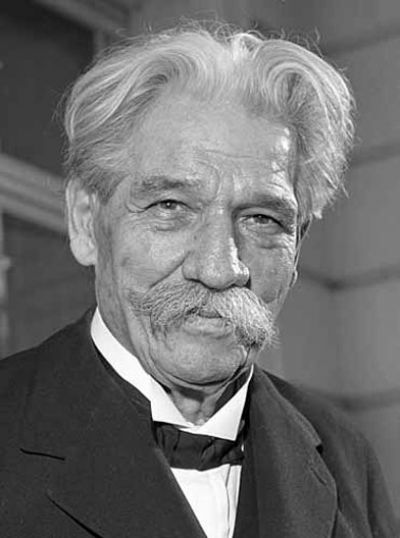
Albert Schweitzer

Albert Schweitzer

I looked for the original source of this quote, but couldn’t find it, so I don’t know the context. If he was indeed nearing 70 when he wrote this, he must have written while serving as a physician at the mission hospital in Lambaréné in what is now the central African nation of Gabon (he turned 70 in 1945, and for several years before that he had been unable to return even briefly to Europe because of World War II). He had gone to medical school for the sole purpose of serving as a medical missionary, first going to Lambaréné in 1913 and staying there much of the rest of his life. He returned to Europe mostly in order to raise additional funds for the hospital (biographical details taken from Wikipedia). Thus, he had been displaying kindness and compassion, two of the characteristics he listed, for decades before writing this.  He probably was displaying the other characteristics in his list as well. In fact, he was awarded the Nobel Peace Prize in 1952, testifying to his peace-loving nature. So, why is he still talking about striving to develop these characteristics?

I suspect it is because he knows that genuine maturity is aware of its continued immaturity. The more we mature, the greater our awareness of how lacking we are in maturity. Philip Larkin made a point something like this in the following letter excerpt:

“It’s funny: one starts off thinking one is shrinkingly sensitive & intelligent & always one down & all the rest of it: then at thirty one finds one is a great clumping brute, incapable of appreciating anything finer than a kiss or a kick, roaring out one’s hypocrisies at the top of one’s voice, thick skinned as a rhino. At least I do.” Letters to Monica—letter of 8 November 1952

So someone like Schweitzer by virtue of his maturity was probably more aware than most of us of his shortcomings when it came to simplicity, kindness, honesty, and the rest. I hope I will someday become mature enough to have even a fraction of his self-awareness. I know I will never match him. Still, I’ll try to progress to the extent I can. His devotion to Christ and the poor helped him to mature; I aspire to follow the same path.

Posted in Psyche | Tagged , , , , , , , | 5 Comments

The Week Before Dad Left

Dad went into the memory unit at Christian Rest Home a week ago. A week before that, it didn’t seem that admission was imminent. However, that previous Wednesday, my mom said for the first time, “I can’t do this anymore.” Not “I’m reaching my limit” or “I might not be able to do this anymore,” but “I can’t.” Caregivers from Elders Helpers were assisting three mornings a week and I was providing care most mornings and evenings, but mom was there around the clock every day, with only occasional breaks. Dad, who has dementia, had been having increasing difficulty understanding even the simplest tasks, which made such tasks an ordeal for both him and the caregiver. He also was having trouble standing and walking because of arthritis and the depletion of cartilage in both knees. He needed to be steadied, and sometimes whoever was with him had to support nearly his full weight until he got his balance. The latter was particularly difficult for my mom, who, at age 88, is just two years younger than him and in frail health herself.

I called the nursing home the next day, but couldn’t schedule an assessment until after the weekend. When the nurse came on Monday June 2, she indicated that dad clearly qualified for skilled nursing care, and recommended that he be placed on the memory unit. Fortunately, there was an open bed. We initially hoped the move would be the end of that week, but, because of a regulation that he be evaluated by a physician within 48 hours of admission, it was best for him to go in on Wednesday, the day there would be a physician on-site. We had just two days to get him ready to go. Those days were a whirlwind of making phone calls, shopping for clothes, marking all his belongings, and packing. On Wednesday June 4, my sister, my brother, and I took him in. My mom stayed home, since we all agreed that the initial adjustment for both her and dad would go more smoothly if she wasn’t present

Here are a few observations about the week leading to admission:

• The difference between managing and not managing caregiver stress can be tiny. Dad’s deterioration in functioning was very gradual—he was barely different two weeks ago from the previous week, and had not changed much the week before that, or the week before that. Similarly, mom was not markedly less capable of handling the caregiving load from week to week. Still, the cumulative changes crossed a threshold, and coping gave way to not coping.

• In the rush to get everything ready for admission, we spent less time than usual with dad. Thankfully, outside caregivers were present, so his needs weren’t neglected. Still, it started to seem as if he was partly gone even while he was still there. He didn’t understand what was happening, so from his perspective everything was the same, even though for the rest of us everything had changed.

• Knowing that dad would be leaving soon added poignancy to everyday activities. Even such prosaic tasks as helping him get ready for bed seemed more special when it was the last time we went through that particular routine together.

• My mother, sister, brother, and I all worked to make the transition as successful as possible. We did pretty well at getting tasks done. We didn’t talk much about our feelings regarding this major life event, though. Mom and I talked some about our sadness, but I can’t recall any other discussion of emotion. I wonder, is our family just not very good at talking about loss, or is entry into a nursing home a particularly difficult thing to discuss?

• My sister, brother and I weren’t all needed to transport dad to the home and provide information about him to staff. We all wanted to be there, though. I suspect our participation was for our sakes more than because he or the home wanted us all there.

This is probably a good place to stop. I’ll try to provide occasional updates on how dad, mom, and the rest of us are handling this change.

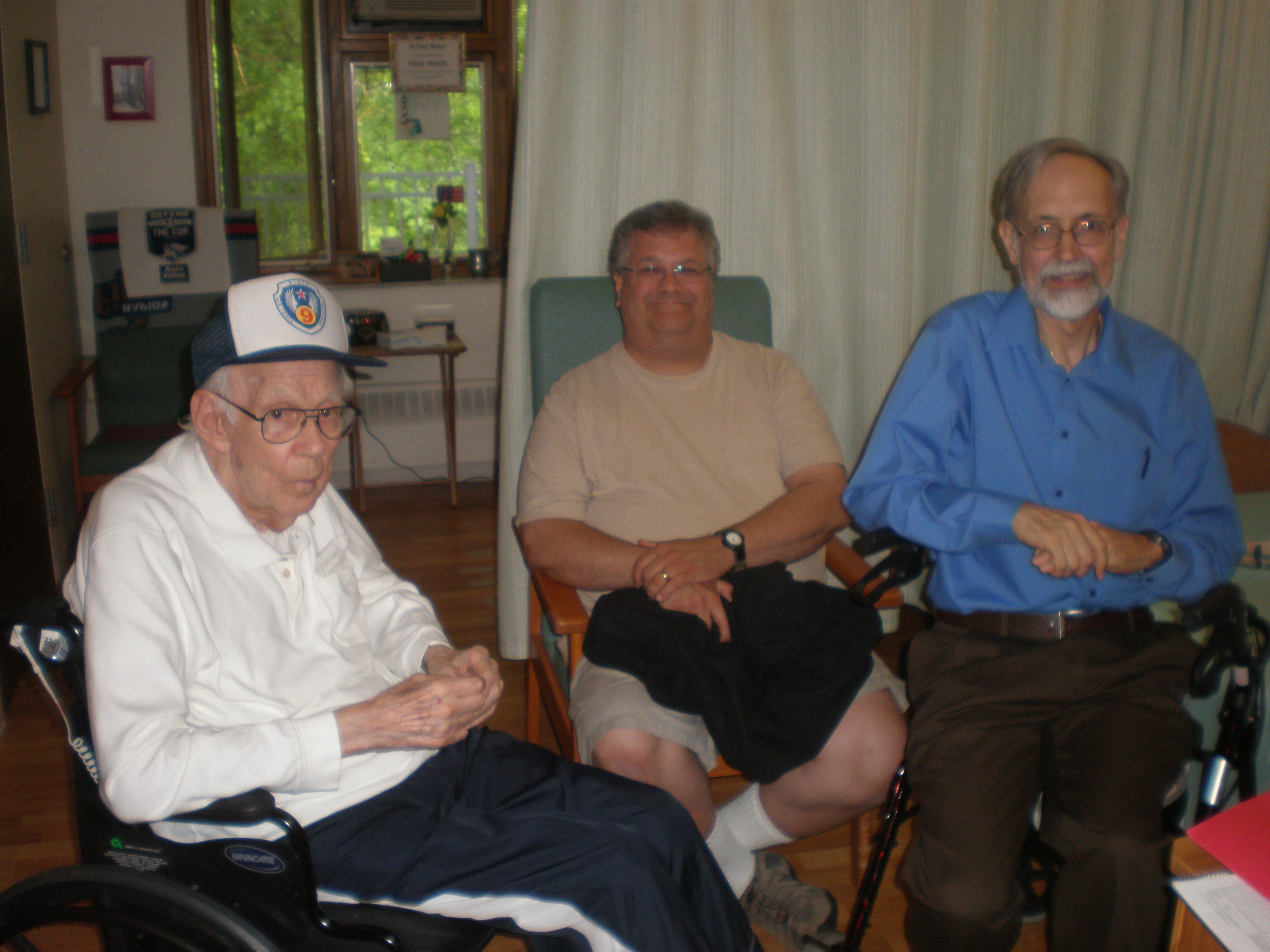
Dad, my brother, and I in dad's new room.

Dad, my brother, and I in dad’s new room.

Posted in caregiving, Psyche | Tagged , , , , , , , | 1 Comment

What It Is Like For Dad To Be Gone

Dad went into the rest home yesterday. He has dementia (apparently of the lewy body variety) and has been deteriorating for years. For the last two years, he could not be left alone and needed assistance with much of daily life–things like bathing, dressing, and toileting. My mom has been his primary caregiver during that time. I’ve helped quite a bit, and, for the last 9 months, we’ve also had caregivers come in three mornings a week. As dad slowly deteriorated, he needed more and more assistance. Finally, a little over a week ago, my mom, who has sacrificed herself heroically over the course of dad’s illness, said, “I can’t do this anymore.” She was tearful, wishing she still had the strength to continue on, but admitting she had reached her limit. We discussed options, and finally decided that the rest home was the best choice.

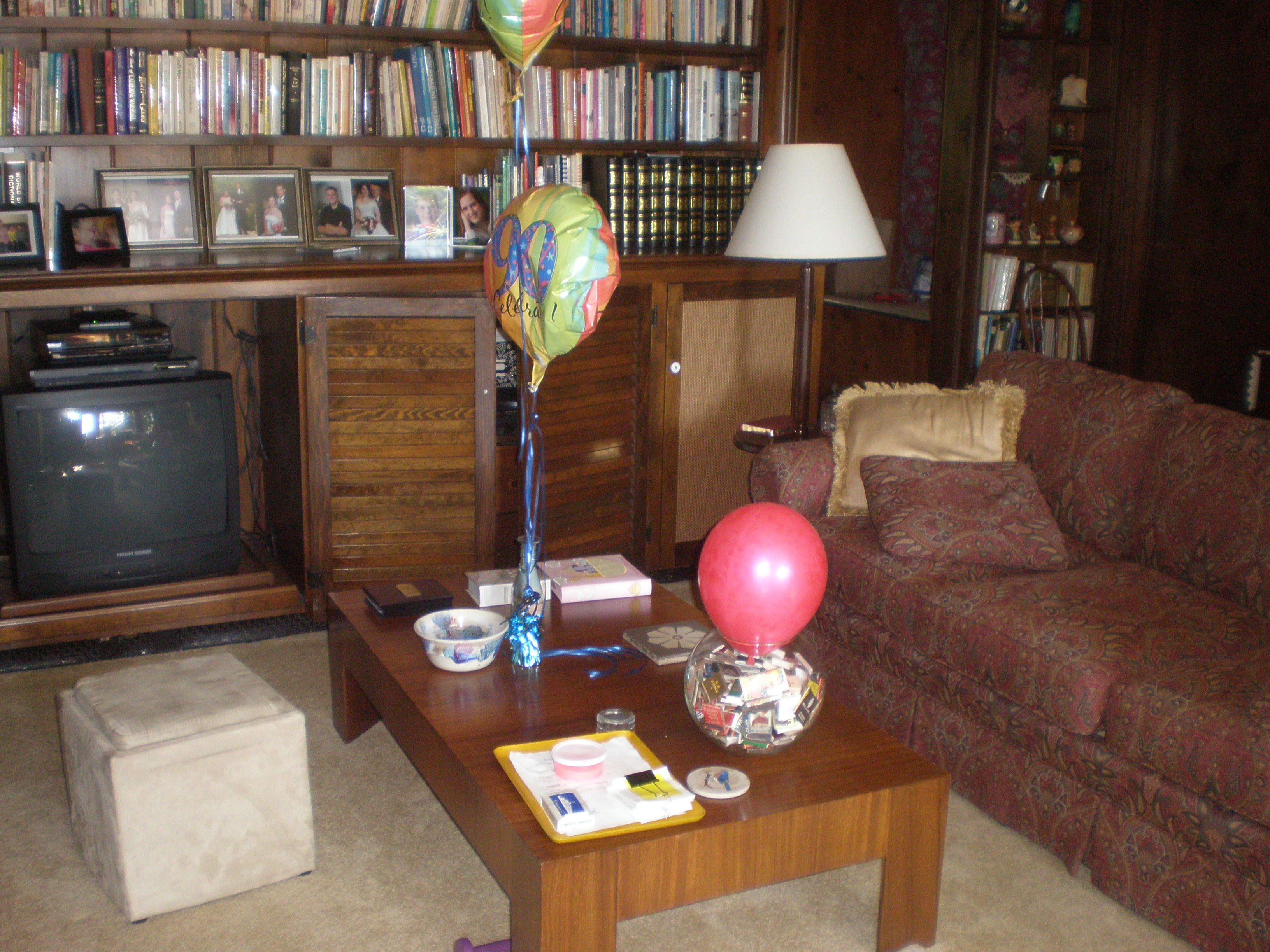
OLYMPUS DIGITAL CAMERAI want to write a few posts about what we’ve gone through during this week. Today I just want to comment on what it is like to spend our first day at home without dad. When we woke this morning, his bed was still unmade from the last night he slept in it. The balloons from his 90th birthday party three weeks ago were still floating in the living room, and the cards we had him sort and weights we had him lift were nearby. His clothes were still in the closet, and his toothbrush, toothpaste, and foot cream were still in the bathroom. The only one of these things that changed during the course of the day is that my sister made his bed. The tangible signs of his presence will remain here for some time.

Dad is also still with us in the activities of the day. I thought often about what I wasn’t doing today that I have been doing so regularly—doing arm exercises with dad, encouraging him to drink water, getting him to stand up and push his walker to the bathroom or the dining room. As my mom and I ate dinner together, she commented, “It seems so strange that we’re talking without dad here to listen to us.” For at least the last year, dad spoke only a handful of words a day and sat in his chair until someone asked him to do otherwise. He didn’t seem to take up much psychic space, so  it is unexpected that his absence would rest so heavily on the house. It does, though.

Blessings in this new phase of life, dad. We miss you.

OLYMPUS DIGITAL CAMERA

Posted in caregiving, Psyche | Tagged , , , , | 3 Comments

Why Belong to a Church Where Everyone Is Younger Than Me?

Why belong a church whose members are all younger than me, most by several decades? The first time I visited Square Inch Community Church, I thought, “Not only am I older than everyone here, my kids are older than most of them.” I’m a retirement-age Boomer, and, judging by appearances, there were just two younger Boomers, quite a few Gen-Xers, and even more Millennials in attendance. Still, I kept coming back, and eventually joined.

Dozens of nearby churches are populated by people near my age. Why didn’t I join one of those? Am I trying to be hip, pretending to be younger than I am? Do I want whatever status accrues to being the oldest or most experienced person present? Do I dislike old people and not want to associate with them? If I’m trying to be hip, I’m not succeeding very well. I dress pretty conservatively, and miss many of the cultural references that my fellow congregants make. I don’t think I’m seeking respect for being the oldest, either. It’s nice when someone expresses appreciation for a comment I make based on my experience, but that doesn’t happen very often, and has little effect on me when it does. Nor do I dislike people my age; most of my closest friends are north of 60, and I like it that way.

So, why am I a member there? Well, why not? Should age make a difference in deciding who to worship with? Granted, many churches sort people into classes, small groups, and the like according to age. I’m not aware of anything in the Bible, in the sacred texts of other religions, or in the Christian tradition that supports such segregation, though.

Mostly, I like Square Inch for things unrelated to age. The liturgy is traditional, its components mirroring elements of the life of faith—confession, adoration, prayer, contemplation, fellowship. Thus, the services aren’t a venue for skilled performances by members of a worship team and aren’t designed to evoke an emotional response. Instead, the intent is to set a rhythm for the week—to disenchant us with the rhythm of the world around us and get us back in time with the cadence of God’s Spirit.

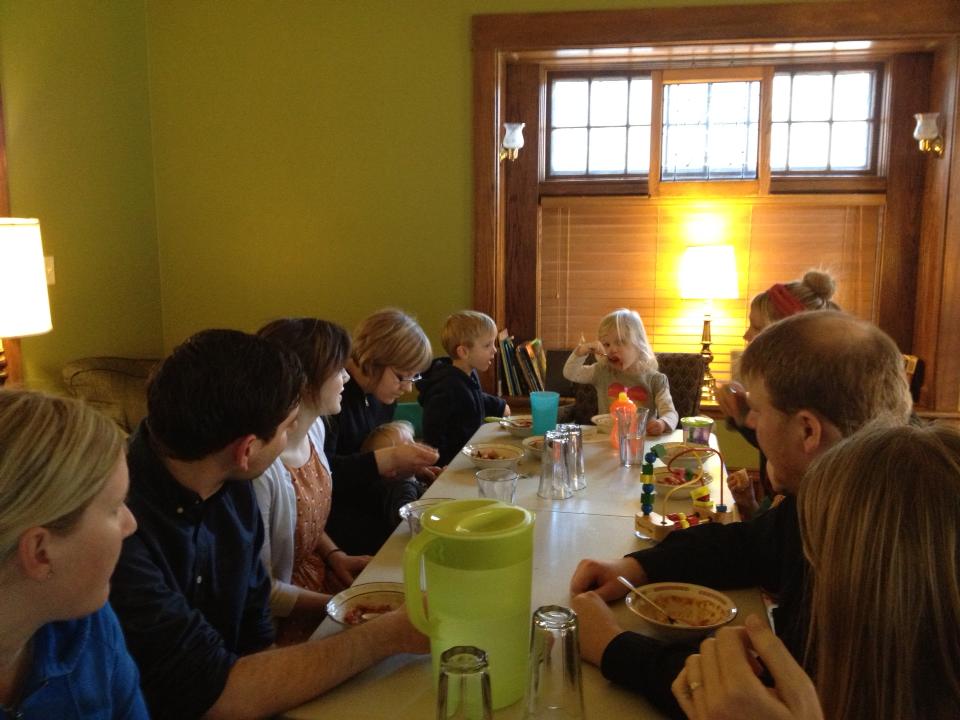
After the service, attending to a different beat continues at a “love feast.” Together we eat a simple meal of soup and bread. In sitting and eating with each other, we connect in ways that tend not to occur during the coffee-and-a-snack-while-standing conversations that take place at most churches. There is richness in how we know the other, and are known. People could choose to sit and eat with those their age—college students at one end of the table, young couples at the other end, and families with kids somewhere in the middle. That doesn’t happen (OK, it does to some extent with the college students), mainly because we are such a small group. Even if I tried to sit with others near my age (which I don’t), I would still be within conversational distance of someone at least a couple of decades younger.

Square Inch Meal

I find that age differences make mealtime conversations resonate for me more than they would otherwise. Doesn’t diversity usually have the potential of enriching faith? I have always been able to better appreciate the immensity of God’s kingdom and the depth of his love when I notice him at work outside my usual habitat—a different religious tradition, a different societal niche, a different culture, and, now at Square Inch, a different age cohort. We “Inchers” talk about our spiritual journeys and discover that God walks simultaneously with nascent adults stepping uncertainly into newfound identities, with middle adults carrying heavy burdens along the pathways of family and career, and with older adults looking back at the ground covered and ahead at what little of the journey still remains. I marvel at how he matches the pace of each of us, bracing us in the difficult places and picking us up again when we fall.

In talking with those much younger, I’m also reminded of myself at various ages. I think back to what it was like to have doubts that God existed, to wonder whether God was calling me to a particular career, or to lose touch with God when distracted by work and family. These memories move me to gratitude for God’s help and mercy all along the road. I’m reminded, too, of my two sons, and am thankful that God has been faithful to them on their spiritual journeys.

While at church activities, I talk about my life experiences much more than I remember doing when in churches where the grey hairs weren’t mostly mine. I regard memories of my faith journey not as bread to sustain me alone but as sustenance for others as well. Do those I talk to think that I’m a source of hope and inspiration, or that I’m a doddering old fellow blathering about the past? Maybe it’s a little of each. Biological families are often both blessed and embarrassed by their oldest members, and the same is probably true of families of faith. Thanks be to God for opportunities to bless and embarrass!


Posted in Spirit | Tagged , , , , , , , | 3 Comments

Why Are Boomers Working Longer?

I recently ran across an interesting article about boomer retirement. The author, James J. Green of Summit Business Media, summarizes a report by the Employee Benefit Research Institute. In 1993, 29.4% of adults 55 and older were in the workforce, a percentage that increased to 40.3% in 2013. For those age 55-64, increased labor-force participation occurred among women but not men, while, for those 65 and older, both women and men were working more.

Are aging adults working longer out of necessity or desire? Maybe it’s a little of each. The EBRI report notes that some older adults stay in the workforce to build retirement account balances or to maintain access to health insurance. Thus, longer workforce participation may be partly attributable to businesses eliminating pensions and reducing retirement packages for departing workers. The report also mentions that some prospective retirees stay in the workplace to pay down debt. Undoubtedly the severe recession of the late 2000s contributed to the debt that now has to be managed.

But working out of necessity is only part of the picture. Green quotes the EBRI report as follows: “Many Americans also want to work longer, especially those with more education for whom more meaningful jobs are available that can be performed into older ages.” The EBRI noted that “the increase in the percentage of those 55 or older in the labor force increased with the high incidence of more highly educated people in this age group.”

Having earned two advanced degrees in psychology, I’m one of the “more highly educated people in this age group.” I certainly can attest to the appeal of the jobs available to me at this point. I can work as a therapist, helping the disheartened to flourish once again. Or I can teach college students, imparting information and skills they will be carrying forward when my days as a porter for knowledge are done. What could be more meaningful than those two opportunities? The jobs that my education qualifies me for also “can be performed into older ages.” I wouldn’t last long as a laborer, an assembly line worker, a longshoreman, or a lumberjack. Thankfully, I should be able to perform job functions such as conversing, note keeping, lecturing, and grading for many more years.

Methodist University, where I worked until two years ago.

Methodist University, where I worked until two years ago.

I had expected to be working full-time even as I approached my full Social Security retirement age of 66, but I’m not. I moved from full-time to part-time work almost two years ago. Many of the hours I thought would be devoted to work are instead devoted to helping my parents. My decision to make major career changes for the sake of family illustrates that Boomers’ decisions about work can be affected by factors besides our retirement account balances and the availability of meaningful jobs. Families matter too, as do lifestyle issues such as how we want to spend our remaining years. I consider myself fortunate to have the choice of whether I work or not; so many others are much more constrained than I am by needs and circumstances.

Posted in Culture | Tagged , , , , , , , | Leave a comment

Caring and the Aging Self

As I’ve written recently, we constantly revise our sense of who we are under the tutelage of life events. I am different today than I was yesterday, though only subtly so, and will be different tomorrow than I am today. I see this as not so much a process of self-reinvention as it is a process of continual renewal. We are, as Alisdair MacIntyre said, at most the co-authors of our stories. God, who is the first author, graciously allows us latitude to write some sentences, though he creates, structures, and develops the chapters. We don’t reinvent ourselves; He renews us.

In relationship with another, I change, as does the other. We become a part of each other’s story—a part of each other’s identity. The more each of us brings our complete selves to our interaction, the more we each are changed.

Nouwen AgingIn their book Aging: The Fulfillment of Life, Henri J.M. Nouwen and Walter J. Gaffney reflected on caring and aging. They wrote, “To care one must offer one’s own vulnerable self to others as a source of healing. To care for the aging, therefore, means first of all to enter into close contact with your own aging self, to sense your own time, and to experience the movements of your own life cycle.” When I try to care while maintaining distance, I may provide some assistance, but am not caring with any degree of completeness. Complete caring means to come near. With the aged, coming near is to recognize myself as aged, to accept that my life is passing away. It is to know myself as grass in the field: “in the morning it flourishes and is renewed; in the evening it fades and withers (Psalm 90:6, RSV).”

For the last two years, I have lived most of the time with my elderly parents. I am there to help them. Some of the time I accept my own aging and care for them from the heart. At other times, I run from my aging and am emotionally reserved. When I am running, I may understand their ways and their needs mentally, but I don’t understand them from the heart. At such times, I am impatient, mentally criticizing the slow and hesitant pace at which they operate. I want to rush on to something I consider important. I thereby diminish their importance, and my own.OLYMPUS DIGITAL CAMERA

All I can say is that I am trying: trying to be completely present with them. If I stay present on a regular basis, my story will be changed and I will be one of them.

Posted in caregiving, Psyche | Tagged , , , , | 2 Comments

Are Your Memories High- or Low-Resolution?

Here’s a comment that most of us would attribute to an older adult: “I can’t remember what I did yesterday, but I can remember the name of my 4th grade teacher.” We seniors are known for being better at retaining long-term memories than at forming new memories. Are our long-term memories really that good, though? How does our ability to retrieve memories of years gone by compare with that of younger adults?

Researchers indicate that long-term memories for life events can be divided into two types and that older adults retain one type better than the other. First, there are memories related to a specific event (usually defined as something occurring within a 24-hour period). Such memories tend to include specific recollections about what was seen or felt that have the quality of actually re-experiencing the event. Second, there are memories about events that took place over an extended period of time or that happened on a number of occasions. These memories don’t have as much sensory or emotional specificity—thinking about them doesn’t have the same quality of mental time-travel that the first type of memories does. An example of the first, high-resolution sort of memory is my recollection of my visit about 11 years ago to my son’s house a couple days after the birth of my oldest grandson. I have a very clear, detailed memory of my grandson lying on the changing table, looking up at me, his limbs slowly rotating as we made eye contact. I remember the feeling of awe and of boundlessness I had at the time. An example of the second, low-resolution sort of memory is my recall of the dozen or so visits to my son’s house over the subsequent few years. I can remember some details, but they aren’t nearly as clear as that initial memory, and the visits run together in my mind.

Compared to younger adults, older adults can’t recall as many high-resolution memories, i.e. detailed memories of specific events. Instead, their recollections tend to be populated with broad, low-resolution  memories—indistinct memories for events that were repeated more than once or occurred over an extended period of time. When older adults do have memories of events occurring on a single day, these often lack perceptual or emotional specificity. Older adults know what happened during such an episode, but usually can’t revisit the moment in a way that brings it back to life.

I’ve been engaging in more life review over the last year or so, which means I’m thinking more about the past. I get frustrated at times trying to call to mind specific memories. So many of my memories are not of discrete events but instead meld numerous instances of the same sort of event–driving a particular route, eating in a particular restaurant, conversing with a particular person–into a single memory. And so many memories have been striped of visual elements. I remember taking three semesters of calculus in college, for example, but can’t remember the classroom, the teacher, my fellow students, or any of the class sessions. As I write this, I’m trying to remember as many college professors as I can. I had more than 30 teachers, but can get a mental picture of only nine of them, and know the names of only six of those. From the research I described above, it seems that my experience is typical. Most of us over 60 have vague, general memories more often than we have detailed, specific ones. Our minds shuffle the deck of memories better than they deal out specific hands.

Except there is one portion of our lives for which we tend to retain more specific, detailed memories. A team of French researchers led by Pascal Piolino of the Universite Rene Descartes found that memories for specific events occurring in the first 17 years of life were particularly well-preserved among older adults. Maybe that’s why most of us are more nostalgic for the days of childhood and adolescence than for the days of our 20s or 30s. We prefer events to which we can mentally return over events we may remember but can’t revisit.

Note: I drew on several studies to compile the above findings. A recent study that refers to all the earlier studies I read is this one. The study by Piolino and colleagues described in the last paragraph is described more fully here.

West Side Christian School, Grand Rapids. I remember lots about it (but not my 4th grade teacher).

West Side Christian School, Grand Rapids. I remember lots about it (but not my 4th grade teacher).

Posted in Psyche | Tagged , , , , , | Leave a comment