On The Ladder of The Generations

I spend most of my time staying with my mother, who is 89 years old. She functions pretty well in her own house, preparing her own meals, dressing without assistance, and doing her laundry. She doesn’t drive or use a computer so I run errands for her both to the store and online. I stay aware of how she is doing and offer help when she seems to be struggling.

Mom's walker. which she is now having to use more.

Mom’s walker. which she is now having to use more.

Almost two weeks ago she injured her back. It was evident that she was having difficulty doing things she normally could do. I asked if I could help with such things as doing laundry or going downstairs when she needed something from the freezer. I tried to set up things to make them easier for her, for example moving food in the refrigerator so she could reach what she most needs. Sometimes I pushed her to take better care of her back, urging her to call her doctor, insisting she ask for help when she needs something she can’t reach easily, and encouraging her to take acetaminophen for the pain. This caused a little tension between us–mom pretty much thinks that things will get better, or not, regardless of what she does. Thankfully, she did go along with what I suggested, and her back is improving.

Mom usually is able to successfully solve problems. She didn’t do quite as well in this situation as she does most of the time. Besides her longstanding tendency to downplay physical limitations, I think age played some role in her not handling things optimally. Perhaps she is becoming more aware that she may lose her independence before many more years and wants to take full care of herself while she can. Doing so might of course lead her to disregard precautions and thereby risk premature loss of independence. I’ll keep an eye on how this goes. For the time being, I’m there to provide assistance but don’t usually have to involve myself in a way that would convey I don’t trust her to manage things.

I not only have an elderly parent; I am an elderly parent. I’m over 65 and have two grown sons. In early June my daughter-in-law helped me get my house ready to sell, and this weekend I will be visiting my son’s family, momentarily putting aside the child role to don the parent role. I wonder how long it will be before my children start to look at me with the watchful concern with which I now look at my mom?

In January, 2014, Judy Oppenheimer wrote an article in Slate about being an aging parent. Oppenheimer is apparently an older boomer, as am I. She notes that at a certain point our children start viewing us differently:

“We’re not dead yet. Most of us aren’t even that out of it. There is a certain facial  expression many of us start seeing in our adult children around the time we hit 65. It involves a faint tilt of the head, accompanied by an intense, pained stare, not unlike that caused by a sudden gastro attack. I’ve named it the ‘uh-oh, she’s starting to lose it’ look. If you haven’t seen it yet, you’re either lucky or haven’t been paying enough attention (or are losing it). Nearly anything can bring it on: a mispronounced name, a forgotten date.”

Oppenheimer goes on to describe situations that can engender the look, most notably ignorance regarding contemporary culture and lack of tech savvy.  She seems a bit defensive, as when she points out that our children aren’t as tech-savvy as their children are, either. I haven’t yet noticed Oppenheimer’s look from my children. Maybe that means I really have lost it. I would like to think it means that, for now anyway, they are aware I don’t know everything they know, but they still respect me for what I do know. In any event, I’m thankful that I can look both up the ladder of the generations to my mom and down to my children, able both to support mom and to have assistance from below when I need it.


Posted in caregiving, Relationships | Tagged , , , , , | Leave a comment

Midlife Complexity to Late Life Simplicity

I wrote in an earlier post that the main psychological challenge of late adulthood is simplification. In middle adulthood, many of us had more complexity in our lives than we had ever had before. At work we took on more responsibility or became specialists who achieved mastery of some abstruse but useful body of knowledge. In our families we had responsibilities not only to those in our own generation but to generations older and younger than us. As to material goods our hoard of stuff grew exponentially from the I-can-fit-everything-I-own-in my-car days of late adolescence to homes with stuffed closets and, for many of us, stuffed garages. In church or community we became the primary doers, the ones with our shoulders to the wheel. Finances, heath, fitness–everywhere we looked, life grew more intricate. Eventually, though, time came for a reversal, for braking rather than accelerating towards more and more complexity.

For those of us who have slowed down, complexity has diminished and we find life is becoming simpler. Those who haven’t decelerated yet may decide on their own to simplify, or something may happen–a heart attack, a financial setback, a job loss–that abruptly initiates the process. One way or another, simplification is coming.

Image from theaposition.com

Image from theaposition.com

Twentieth-century theologian Lewis Joseph Sherrill, who convinced me that simplification is the main task of older adulthood, thought that late-life simplification benefits us because it forces us to put aside what is less important in our lives so that we will focus on what is more important. He believes there are several areas in which elders move toward greater simplicity. Here are the areas he lists, with a brief description of what happens in each as we discard those things that complicate life:

  • Simplification of status–we chose to take or are relegated to less prominent positions at work, in the family, and in the community.
  • Physical simplification–our bodies fatigue more easily, can do less than before, and eventually suffer illnesses.
  • Material simplification–we dispose of some of the possessions we’ve accumulated and downsize our living arrangements.
  • Simplification of character–we drop pretenses and present ourselves more honestly; the core elements of our character become more prominent.
  • Spiritual simplification–we focus less on peripheral spiritual practices and beliefs, but more on practices and beliefs which nourish our souls.

Over the next several weeks I’ll focus on each of these in turn, exploring what it means to simplify in each realm. I’ll be thinking of where I have simplified and where I still need to simplify. I invite you to do the same.

Posted in Psyche | Tagged , , , , , , | Leave a comment

Loss and Simplification in Later Adulthood

In my last post, I introduced the idea that the main psychological task of late life is to mourn our losses. I ended by suggesting that such grieving does not mean that we older adults are constantly in a state of sadness and mourning. Proper grieving in fact relieves negative emotions and leads to peace. In addition, grieving helps us mature. We benefit greatly by the process of letting go.

Catholic priest Ronald Rohlheiser states that good grieving “consists not just in letting the old go but also in letting it bless us.” Rolheiser suggests that mourners are blessed when they accept every aspect of their lives—their origins, decisions, dispositions, relationships, and experiences—rather than rejecting or hiding those things that now seem wanting. For example, he distinguishes between his childhood companions who did and who didn’t accept their origins in a poor community comprised mostly of Eastern European immigrants to Canada. Some who grew up there never visit and are ashamed of their humble backgrounds. Others are proud of their roots, recognizing that the hardships they faced early in life prepared them for later successes. The latter group are those who are blessed by their origins.

Like Rolheiser, Lewis Joseph Sherrill also thought that the main task of late adulthood is letting go, but he conceived of that task not as grieving losses but as simplifying one’s life. Sherrill (1892-1957) was a professor of religious education at Louisville Presbyterian Theological Seminary and later a professor of practical theology at Union Seminary (New York). In his book The Struggle of the Soul (1951), Sherrill proposed that human psychological development consists of five stages, each of which is characterized by an inward propulsion to grow or achieve some goal. He thought our inclination towards growth is similar to the propensity of a seed to germinate or a young bird to learn how to fly. Unfortunately, our proclivity to grow is in tension with another tendency: to fear growth, to shrink back “from the hardships, the risks and dangers, the suffering.” When we shrink back, we fail to mature.

The five stages Sherrill lists and the goals associated with each are:

• becoming an individual, characteristic of childhood
• being weaned from the parents, characteristic of adolescence
• finding one’s basic identifications, characteristic of young adulthood
• achieving a mature view of life and the universe, characteristic of middle adulthood
• simplification of life, characteristic of old age

file cabinet CoolClips_busi0347The simplification of late life consists of “distinguishing the more important from the less important, getting rid of the less important or relegating it to the margin; and elevating the more important to the focus of feeling, thought, and action.” So simplification is a pruning–we’re cutting away the weaker branches so that the rest grow stronger. Or, to use another analogy, we are going through our overstuffed file cabinets to discard records we no longer need and rearrange the rest so they are more useful. I have actually been culling out old files recently. I had saved so many records that I no longer need! I’ve had fun finding important files that had gotten lost in all I had accumulated. I’m seeing firsthand the benefits of simplifying!

Some of us are hesitant to move forward with simplification. We shrink back during this stage of life if we cling to what is no longer important and don’t recognize what we most need going forward. Those who shrink back are living in the past. They can’t imagine letting go of anything.

In a subsequent post I’ll describe more of what Sherrill has to say about simplification in late adulthood.

Posted in Psyche | Tagged , , , , , | Leave a comment

What is the Primary Psychological Task of Late Adulthood?

Psychologists usually view human development as consisting of a series of tasks or issues, each of which must be dealt with in turn. Thus infancy is about learning to trust, adolescence about independence and identity, and early adulthood about intimacy. But what is the psychological task of older adulthood?

Students of developmental psychology know the textbook answer, first given by psychoanalyst Erik Erikson: to achieve ego integrity, or, failing that, to lapse into despair. According to this view, the older adult engages in a life review, looking back over the decades at choices made, accomplishments, and outcomes. If that review results in the person concluding that he or she made a significant contribution and that life was meaningful, that person will have a sense of ego integrity. In contrast, those who see their lives as patterns of wrong choices, missed opportunities, and failures will experience despair.

Most of us older adults do think back over what we’ve done or failed to do with our lives. In my work as a therapist, I have worked with a number of older adults who were either struggling with discerning the meaning of their lives or had ended their life review washed up on the shoals of despair. Those who were eventually able to resolve these issues experienced significant relief. So life review is important. That’s not all that’s going on in our psyches, though.

One limitation of viewing late life as being primarily about ego integrity vs. despair is the emphasis this puts on the ego: on our individual self-evaluations and self-justifications. Is the ego that important? Aren’t we much more than the measure we take of ourselves? Another issue pertaining to life reviews is that such reviews may be quite inaccurate. Might not someone who has though the years been manipulative, exploitative, and pernicious but has well-rehearsed excuses for such faults end up feeling pretty good about his or her life? Might not a genuinely kind and nurturing person who is unfortunately rather self-critical focus only on past mistakes and wind up in despair?

Thus, the process of life review may be less a true assessment of one’s accomplishments and more a manifestation of one’s defenses. Besides, in many cases life review doesn’t seem to be the final psychic act we perform. Many of us assess our lives around the time our career ends or our children leave home. We may then have more than thirty years still remaining to us. Will our psyches lie fallow for all that time?

An alternate conception of psychological development in late life holds that some older adults achieve gerotranscendence–a state characterized by decreased focus on the self and increased cosmic awareness. Still another view is that the main psychological issue of late life is to deal with the loss or relinquishment of many things that formerly give life meaning. Catholic priest Ronald Rolheiser is a proponent of this view:

Ronald Rolheiser

Ronald Rolheiser

“[P]erhaps the greatest spiritual and psychological challenge for us once we reach mid-life is to mourn our deaths and losses. Unless we mourn properly our hurts, our losses, life’s unfairness, our shattered dreams, our radical inconsummation, and all the life that we once had but that has now passed us by, we will live either in an unhealthy fantasy or an ever-intensifying bitterness.” The Holy Longing, p. 162,3

Astutely, Rolheiser notes that we need to grieve not only what we have lost but what we wished for but never had–“our shattered dreams, our radical inconsummation.” Rolheiser points out that if we never acknowledge what is gone, we live in unreality, i.e. in a world of fantasy. If we recognize what is gone but avoid grieving it, we are likely to become bitter.

The claim that the main psychological task of old age is to deal with loss and relinquishment seems rather bleak. Yet dealing with loss does not mean constant sorrow. There are significant positives that result from honestly looking at what we have lost or are going to lose. I’ll discuss those positives in an upcoming post.

Posted in Psyche | Tagged , , , , , , , , | 2 Comments

I Went to a Concert by Myself. So Can You.

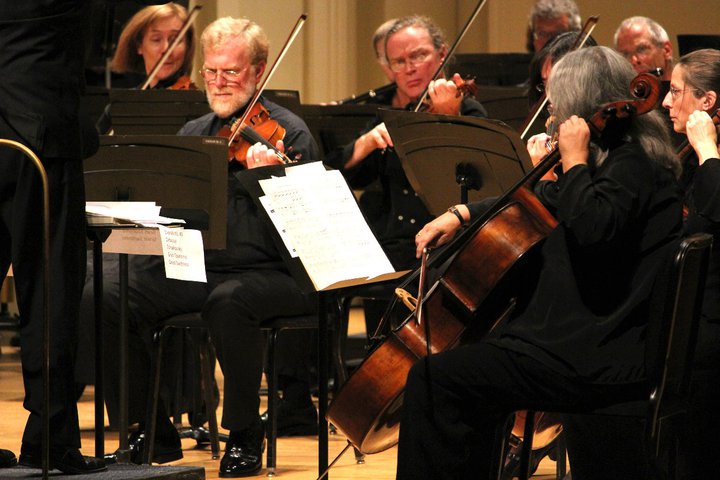
Grand Rapids Symphony. Photo from grsymphony.org

Grand Rapids Symphony. Photo from grsymphony.org

Last month I went to a baroque music concert by myself. I’m not dating or married to anyone, and trying to find someone to go with me seemed too much trouble. The Grand Rapids Symphony did a marvelous job, as did the soloist, soprano Kathryn Meuller. I was particularly struck by Rebel’s “Chaos,” which is unlike any piece of Baroque music I had ever heard. I had a good time…except.

Except I was a little uneasy going by myself. There were lots of couples there, and some groups, but no one else that I saw sitting alone. I was violating the informal norm that concerts or shows are attended with others. What would those at the concert think of this guy sitting by himself? I told myself that others’ reactions didn’t matter, but, as social psychologists have discovered, norm violations do evoke anxiety in nearly all of us.

I’m certainly not the only one facing the question of whether to go to public events by myself. After all, lots of us live alone. Currently, 27 percent of U.S. households consist of just one person, compared to 17 percent in 1970. That makes for 32 million one-member households. Worldwide, the region with the highest rate one-person households is Western Europe with 31 percent; the lowest rate is in Asia, with just under 9 percent (Statistics from CBS News). There are certainly a lot of us who would have to look outside our home for someone with whom to go places!

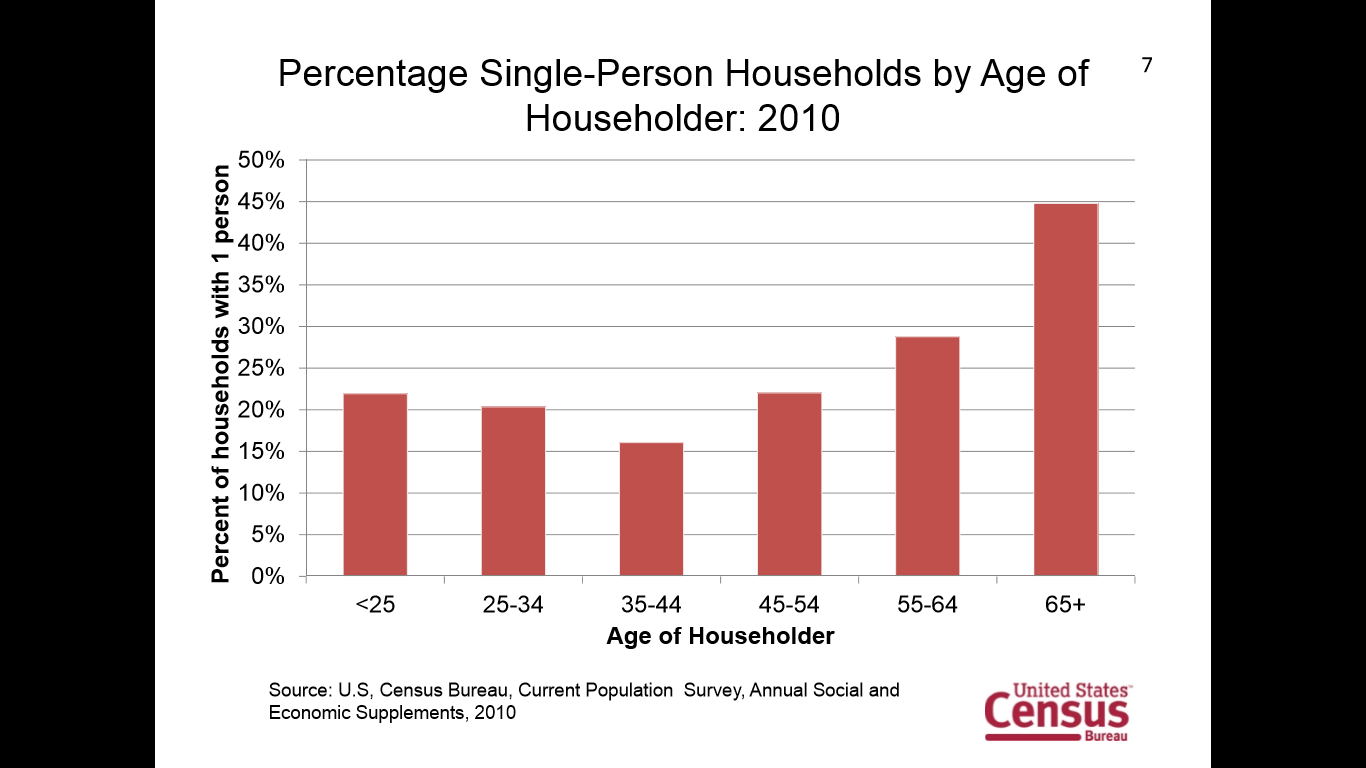
The growth in the number of single-person households is to a large extent fueled by young adults marrying later than used to be the case. However, the age group with the highest percent of people who live alone is not young adults but the elderly (see the accompanying chart from the U.S. Census Bureau for a comparison between age groups). In 2012, about 28% (11.8 million) of all noninstitutionalized older persons lived alone (8.4 million women, 3.5 million men). They represented 36% of older women and 19% of older men. The proportion of those living alone increases with advanced age. Among women aged 75 and over, for example, almost half (46%) lived alone. (These statistics are taken from the Administration on Aging.)

Single Person Households


If more and more of us will be living alone as we age, wouldn’t it be good to become comfortable going to concerts (and movies, plays, sporting events, and restaurants) by ourselves? A study by marketing professors Rebecca Ratner and Rebecca Hamilton that will be published later this year in the Journal of Consumer Research looked at the reluctance to do such things alone. (The study was discussed in The Atlantic.) The researchers posited that people hesitated to do things by themselves both because they thought they wouldn’t enjoy themselves as much as if they were with someone else and because they thought others would judge them negatively.

In one experiment, the researchers asked participants questions about doing activities either alone or with friends. The activities were either hedonic (i.e. usually engaged in for enjoyment) or utilitarian (usually engaged in to accomplish some goal other than enjoyment–e.g. going to the grocery store). The hedonic activities were further divided into those usually done in public (e.g. going to a restaurant for dinner) or usually done in private (e.g. playing a video game on one’s computer). Participants thought they would enjoy the hedonic-public activities more when done with others than when done alone. They also thought that, if they did these activities alone, others would infer they had fewer friends than if they did them with friends. Neither of these patterns of responding held when participants thought about private hedonic activities (e.g. a video game at home) or public utilitarian activities (e.g. a trip to the grocery store). In neither case did participants expect that, if they did the activity alone, they would enjoy the activity less or be judged as having fewer friends.

In a follow-up experiment, the researchers stopped 86 people walking through a college’s student union either alone or in a group. The recruited people were asked how much they thought they would enjoy a walk through a nearby art gallery, and then went through the gallery either alone or with the group they were with in the student union. Those contemplating going through the gallery alone predicted lower levels of enjoyment, but ended up enjoying the experience about as much as those who went with others. Thus, the expectation that we won’t enjoy doing things in a public place by ourselves may not be accurate.

So, if we were to get over our concerns about being judged negatively by others and started going to more “hedonic public” events by ourselves, we probably would enjoy ourselves more than we expect. Plus, we would be contributing to societal change. “We need the norms to shift a little. We need for people to think it’s a gutsy cool thing to have fun on our own,” lead researcher Ratner told Roberto A. Ferdman of the Washington Post. “Someone needs to start the new trend.”

Why don’t we unattached older adults be the first ones to go out and have fun on our own? We’ll do both ourselves and society some good. Having gone to a concert once, I’m ready to do more things alone. If you come to Grand Rapids, you may encounter me sitting by myself at a restaurant or theater, looking around to see whether the rest of you are joining me!

Posted in Culture, Relationships | Tagged , , , , , | Leave a comment

The Old Age Style

Some time ago I ran across an  article from 1972 on the style characteristic of elderly artists. The author, Kenneth Clark finds in their works several common features, which he identified as follows:

“Now let me try to summarise the characteristics of the old-age style as they appear, with remarkable consistency, in the work of the greatest painters and sculptors. A sense of isolation, a feeling of holy rage, developing into what I have called transcendental pessimism; a mistrust of reason, a belief in instinct. And in a few rare instances the old-age myth of classical antiquity–the feeling that the crimes and follies of mankind must be accepted with resignation. All this is revealed by the imagery of old men’s pictures, and to some extent by the treatment. If we consider old-age art from a more narrowly stylistic point of view, we find a retreat from realism, an impatience with established technique and a craving for complete unity of treatment, as if the picture were an organism in which every member shared in the life of the whole.”

Clark describes numerous works that display these features. Here is one such piece, Michelangelo’s “The Conversion of Saul.” The scene is tumultuous; Saul seems no longer aware of the people who surround him, but instead is held in thrall by the fearsome power of the risen Christ:

Michelangelo The conversion of Saul

Here is another example, Titian’s “The Martyrdom of St. Lawrence.” Like Paul, St. Lawrence is surrounded by people yet no longer with them. He has been transported by power from above which has given sight to him just as it gave blindness to Paul:

Tizian Martyrdom of Saint Lawrence

Here is Rembrandt’s “The Conspiracy of Claudius Civitas,” as reworked by the artist after it was returned to him by the city fathers of Amsterdam, who had commissioned the work but were dissatisfied with it. Rembrandt ignored their request to rework it to their specifications, instead modifying it to fit his vision.

Rembrandt_Conspiracy_of_Julius_Civilis

As I looked at these works and several others, I wasn’t persuaded that pessimism is at the heart of the old age style. I see in them a sense that most human projects are insignificant, perhaps even fatuous, but that just makes the contrast with the transcendent more stark. There may be skepticism that human plans will succeed, but that’s not the same as thinking that everything bodes ill. There seems to be hope not because of human efforts, but in spite of them.

Clark’s essay reminded me of Richard Rohr’s Falling Upward. Rohr contrasts spirituality in the first and second halves of life. First-half spirituality is ego-driven, aimed at making ourselves feel special, carving out a place where we belong and helping us achieve some success there. The focus is on “order, control, safety, pleasure, and certitude.” Second-half spirituality entails leaving that place of safety at God’s behest. We usually take that step not because we want to but because we are forced to when we encounter failure, loss, or disappointment. Away from what is familiar and reassuring, we stumble along the path that leads us to the truth about ourselves and the world. Don’t these late-life works of art help us see such unconventional, discomforting truths?

Rohr says the following:

“We are both driven and called forward by a kind of deep homesickness, it seems. There is an inherent and desirous dissatisfaction that both sends and draws us forward, and it comes from our original and radical union with God.”

Perhaps, rather than pessimism, the old age style is characterized by this dissatisfaction with what our days consist of. The elderly artist is homesick, tired of the ephemera of life. He or she is drawn forward, painting or sculpting or drawing not for others but to express a longing that cannot be consoled.  Such dissatisfaction evokes our own longing, which is an uncomfortable blessing for us. I’m thankful for art that prompts me to yearn for that which lies beyond the realm of sight.


Posted in Culture, Spirit | Tagged , , , , , , | Leave a comment

On Being an Aging Runner

I recently ran in a 5-kilometer race, a fundraiser for college scholarships. I did pretty well, all things considered, completing the course a little more than a minute faster than the goal I had set. Admittedly, my goal was rather modest. A man pushing a two-seat baby stroller zipped past me on the downhills; I caught him again going up-hill. I was beaten soundly by several 9-year-olds and even a couple of 8-year-olds. At least I’m still ahead of the 7-year-olds!

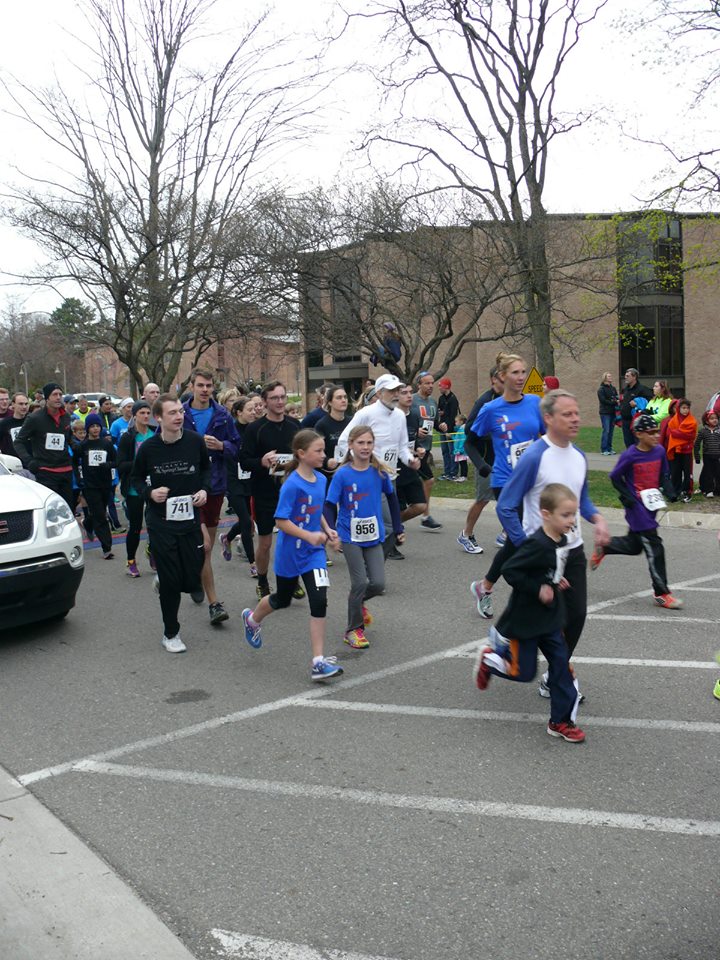
At the Calvin Spring Classic. I'm in the white hat. Photo by Carlie Bergsma/Chimes

At the Calvin Spring Classic. I’m in the white cap. Photo by Carlie Bergsma/Chimes

I’ve been a runner for about 40 years–longer than that, if I count a brief, dismal stint on my high school’s cross-country team. I never could run long distances very fast, but once I could run much faster than I do now. Around age 30, I could run comfortably at an 8-minute-per-mile pace; now, I typically plod along at about 11 minutes a mile. My ankles, knees, and hips all protest, so I can only run twice a week, not enough to improve. Age changes things.

Why do I bother running at all anymore? And why did I enter a race in which at best I would finish in the middle of the pack?

I run because exercise benefits my body. According to the Centers for Disease Control in Atlanta, older adults who exercise are less likely to die of coronary heart disease or to develop hypertension or diabetes. Their bones are stronger and they are less likely to experience falls or fractures. Admittedly, running is harder on the joints and more likely to cause injury than many other forms of exercise. Because of this disadvantage, I spend less than half of my exercise time running. I also go to the gym to use an elliptical machine, a stationary bike, and a rowing machine. I keep running not because I think it’s better than these other forms of exercise but because of what running means to me.

I usually run early in the morning, when there are few cars on the road and hardly any people about. Houses along the route are coming to life; I have some sense of being connected with the inhabitants, though they don’t know I’m passing. Running through whatever weather is extant, able to go whichever direction I choose, I feel free. In contrast, trips to the gym tether me to machines–first the car I take there, then the exercise equipment outfitted with stirrups to hold my feet and displays to keep time and quantify my effort. Running also connects me to history in a way that gym machines can’t, all the way from ancient history (the Olympics, the plain of Marathon, Asahel and Abner) to my own history. I remember lots of places I’ve run and friends I’ve run with. I still have a t-shirt from the late 1970s that I received for participating in the Volksläufe (people’s race) still held annually in Frankenmuth, Michigan. No form of exercise (with the possible exception of swimming) evokes for me the rich memories that running does.

Why enter a race, though? I knew I wouldn’t win or even be best in my age group. I haven’t been in many races over the years–this was my 10th or 11th, and was the first one for about 5 years. I’ve thought some about what the appeal was, and I’ve come up with two things.

First, when running with so many other people (over a thousand entrants), there is motivation to run as fast as I can. The drive is in part competitive: in this race, I put forth a good deal of effort trying to finish ahead of a guy who passed me near the first mile marker and whom I could tell was older than me. Beating someone else is less important than knowing I have done my best, though. A race gives me the opportunity to push myself to my limit and shows me what I’m capable of doing. The exhaustion that I feel afterwards is well-earned and thereby satisfying.

Second, I like to see the other racers. It’s refreshing to know that there are so many runners living nearby. The participants were of all shapes and sizes, serious or casual, running in groups or alone, ranging in age from six to over eighty. We formed a very temporary community, moving forward together, a sweaty, straining convoy all with the same destination. For a few months after a race, my solitary runs don’t seem so alone because I know that many of the people with whom I ran will have continued putting on their shorts, lacing up their shoes, and heading out for a run, just like I do.

So, I’m the old-but-not-yet-decrepit guy in your neighborhood, running rather slowly. I’m not out to prove anything. I’m just glad that I can still be doing this, thankful that my ankles, knees and hips have allowed me one more day that I can call myself a runner.

Posted in Body | Tagged , , , , , , | Leave a comment

Sex and Dementia

What’s entailed in expressing consent to have sex with someone? If the person wanting to have sex with you is your husband, and you don’t object to sex with him, is that enough? If you’re openly affectionate with him, wouldn’t that pretty much clinch it? But what about if you also happen to have dementia?

That was the question raised by the case of Henry Rayhons and Donna Lou Rayhons of Garner, Iowa. The couple had each lost their previous spouses. Each in their 70s, they formed a close bond with each other after meeting in the Catholic church choir in which both sang. They married in December, 2007. However, in 2009 Mrs. Rayhons began to show signs of dementia. She was placed in a nursing home in March, 2014. Henry visited his wife morning and evening, often praying the rosary with her.

Henry Rayhons. Photo by Daniel Acker/Bloomberg

Henry Rayhons. Photo by Daniel Acker/Bloomberg

According to Bloomberg News, on May 15, 2014, the nursing home staff met with Mr. Rayhons and two of his wife’s daughters. The staff informed him that a local physician had decided that Donna no longer had the mental capacity to consent to sex. Mr. Rayhons replied that that was “not a problem.”

However, eight days later, Donna’s roommate reportedly heard “sexual sounds” coming from Donna’s part of their room, where Henry had apparently drawn a curtain around himself and his wife. Prosecutors claimed that his semen was found on a quilt and sheet from Donna’s bed. Henry reportedly admitted to an investigator that he and his wife had had sex that day, but denied it while testifying at his trial for felony sexual assault.

What would consent for sex look like in a patient with moderate or severe dementia? An  article about the Rayhons case in the New York Times cites Gayle Doll, director of the Center on Aging at Kansas State University, to the effect that such a person may not be able to assent with words but still be able to give assent by body language or facial expression. This way of thinking about assent would mean that it can’t be assessed by measuring the person’s ability to perform cognitive tasks, but instead must be determined by observing that person’s response to the prospective sexual partner. The nursing home in this case doesn’t seem to have conducted that sort of assessment. Would the conclusion have been different had they considered the affection the couple displayed when Henry visited? Donna reportedly was glad to see him and they held hands on the unit.

The defense attorney asked two physicians testifying for the prosecution whether Donna’s positive response to her husband’s visits showed that she was capable of understanding her relationship with him. Both said no, one of them saying of those with dementia “They do have feelings, but they don’t have good judgment.” So it takes good judgment to have sex? How many of us, young or old, have ever failed to meet that criteria before hopping in the sack?

The trial concluded on April 22 with a not guilty verdict. Perhaps the jurors believed Henry’s denial, or perhaps they they thought Donna was capable of giving consent.  Acquittal must have been quite a relief for Henry and his family, though perhaps not for his daughters-in-law, who reportedly had clashed with him about their mother’s care.

A couple of experts cited in the NYT article discussed the discomfort and disapproval they had seen among nursing home staff on the subject of sexual activity among residents. In all likelihood, the society as a whole shares that disquiet. However, with the number of persons over 65 with Alzheimer’s expected to grow dramatically–from 5.1 million now to 7.1 million in ten years–it’s an issue that will come up with increasing frequency. Perhaps our society will eventually reach a point that we recognize that human affection and intimacy are important for all of us, even those who can no longer express these needs well.

Posted in Relationships | Tagged , , , , , | Leave a comment

Retirement Leisure vs. Sabbath Rest

wrote a few months ago about leisure in retirement, suggesting that one benefit of leisure is to remind us that the value of human life isn’t measured solely by the yardstick of productivity. In this post, I will compare leisure with something else that involves cessation from work, namely the Biblical concept of Sabbath rest.

Garden of Eden, by Jacob de Backer.

Garden of Eden, by Jacob de Backer.

The term “Sabbath” comes from the creation account in the Hebrew Scriptures. The Hebrew term “sabbat” means to cease, quit, or stop; thus, it refers to a pause in activity. Genesis describes God working for six days, creating the heavens and the earth. He then rested the seventh day, establishing the Sabbath as a time of rest. In the Mosaic law, the Israelites are commanded to cease work one day out of seven. Eugene Peterson describes the purpose of this time of rest as follows:

“Sabbath is a deliberate act of interference, an interruption of our work each week, a decree of no-work so that we are able to notice, to attend, to listen, to assimilate this comprehensive and majestic work of God, to orient our work in the work of God.” Christ Plays in Ten Thousand Places, p. 110

So Sabbath, unlike leisure, alternates with work. The time is set apart, or holy, in that it is a disruption of our normal routine. The retiree who plans an uninterrupted life of leisure isn’t alternating leisure with anything else. Unlike the Sabbath rest, a life of pure leisure isn’t an in-breaking of another mode of being in the world.

Besides leisure and Sabbath being different in that the first is uninterrupted and the second alternates with work, the purpose of leisure and Sabbath are different. The Sabbath is, as Peterson indicates, a time to reflect on something much bigger than one’s own work, namely the work of God. Leisure doesn’t point us to something larger than ourselves, to the work of the Creator. Retirement leisure instead reminds us of the decades of work for which we are now being rewarded. Such a life of uninterrupted inactivity can easily be lived with a sense of entitlement rather than a sense of gratitude for God’s gracious provision, his creation work having enabled our work to be fruitful.

What would it be like to focus one’s retirement neither on activity or leisure but on Sabbath rest? Such a retirement might have the following characteristics:

  • a balance between times of active engagement (be that work, volunteering, informal helping, or some other activity) and times of reflection
  • both when active and when at rest, greater awareness of spirit–both the divine Spirit and our own spiritual needs and longings
  • gratitude–the recognition that life and all that it entails is a gift

Elderhood gradually becomes less a time of doing and more a time of being. Perhaps, should we live long enough that our doing diminishes to almost nothing, the ideal state of being in which to live would be Sabbath rest.

Posted in Spirit | Tagged , , , , , , , , | Leave a comment

Stress Management in Older Adulthood

Image from health.howstuffworks.com

Image from health.howstuffworks.com

You’re not stress-free, are you? Neither am I. And we won’t rid ourselves of stress, either. If you’re a middle-aged adult working long hours, raising kids, negotiating relationship problems, cooking, cleaning, and trying to keep your environment from falling into ruin, you know what stress is. You may look forward to the day when all these demands on you will subside, and life will be relaxed and peaceful. Talk to those of us whose kids have grown and who are fully or partly retired, though, and you’ll learn that no one is without stress. Maybe we seniors don’t have the time pressures that younger folks do, but we have stresses of our own–doctor’s appointments, illnesses, financial strains, losses, troubled relationships, and uncertainty about the future. Alleviate one stress–moving out of a now-too-big house–and you create another–adjusting to a new home.  What stress would you like in life? Don’t say ‘none’ because that isn’t an option.

As an adult in my 60s, I don’t think I could still manage all the family, work, and community responsibilities I had 30 years ago. Is that simply because I have less energy than I did, or does it mean my ability to handle stress is deteriorating? Will I eventually not be able to tolerate stress at all?

I was reassured when I found a study that looked a reactions to stress in younger and older adults (the reference is: Oliver K Schilling and Manfred Diehl, Reactivity to stressor pile-up in adulthood: Effects on daily negative and positive affect. Psychology and Aging, Vol 29(1), Mar, 2014. pp.72-83). The study participants completed measures every evening for 30 days, indicating what stressors they had that day. They also completed a scale measuring their emotions each day–there were ten  emotions, half positive and half negative.  The researchers found no significant differences in the amount of negative emotion that younger and older adults experienced in response to multiple stresses that hit in close proximity. That’s nice to know; according to this study, anyway, there doesn’t seem to be any age-related deterioration in how a day filled with stressful events affects us.

The news was even better when it came to “stressor pile-up.” The term refers to the times when we’re hit by stressful events day after day. Do older adults get more worn down emotionally by those runs of misfortune–sickness one day, a computer crash the next, then a falling out with a friend, a lost wallet, and on and on? No. Actually, older adults have fewer negative emotions than do younger adults when stressors pile up over a number of days. In this sense, we get better, not worse, at handling stress.

Why might older adults be better at handling such cumulations of stress? The authors suggest that over the years we may have developed more effective strategies for handling stress than those used by younger persons. For example, we may be better at finding the positives in a bad situation or putting things in context. These strategies may take time to implement, so that older adults are just as unhappy as younger adults the same day that multiple stresses hit. However, as stress continues, the effectiveness of their more self-reflective strategies become apparent.

The study is limited in that it compared different groups of old and young adults rather than following the same adults over the years; it’s also limited by the particular sample and measures used. Still, it’s nice to have evidence suggesting that stress management improves as we age. Maturity has its benefits!

Posted in Psyche | Tagged , , , , | Leave a comment