Dealing With Bereavement: Irrational Thoughts and Hope

In Joan Didion’s memoir of grief, The Year of Magical Thinking, she reports that her thoughts were often irrational. Her husband John Gregory Dunne died on December 30, but, according to her, “It was deep into the summer… before I recognized that through the winter and spring there had been occasions on which I was incapable of thinking rationally. I was thinking as small children think, as if my thoughts or wishes had the power to reverse the narrative, change the outcome.”

She first noticed such magical thinking the night after John died. She didn’t want anyone to stay with her that night. Later, she realized that at some level she believed that what had happened was reversible and she needed to be alone so he could come back. A few weeks later, when she was giving away his possessions, she found herself unable to give away all his shoes. She reports, “I stood there for a moment, then realized why: he would need shoes if he was to return.” In another instance of illogic, she wanted an autopsy, but later realized the reasoning behind that desire: she hoped that, if the autopsy revealed that the problem was something simple, the doctors might be able to fix it.

John Gregory Dunne and Joan Didion

John Gregory Dunne and Joan Didion

Didion didn’t reveal these thoughts and others like them to anyone, so she knew even while having them that others would think them peculiar. She mostly regarded them the same way herself, but they still affected her actions. Some of the thoughts she describes were not so much actual beliefs as suspicions hovering around the edges of consciousness–that she allowed John to die, that he abandoned her. These latter two have come up fairly often in my work with people who are grieving. I’ve noticed that believing that one is responsible for someone’s death impedes progress through the process of grieving. The person has often been told by others that they weren’t to blame, but the thought lingers. Why is it so hard to shake? Perhaps it’s a matter of the childlike magical thinking that Didion saw in herself; young children haven’t learned the limits of their powers, and thus may think that they could make something happen just by a thought. We are probably all susceptible to such magical thinking if under enough duress. When a loved one dies, magical thinking accuses us of not having wished hard enough for them to live.

Interestingly, Didion didn’t permit herself another type of thought that, in marked contrast to such self-accusations, comforts many grievers. She didn’t let herself think that we survive death. Whether it be the Christian’s bodily resurrection, popular imagination’s ghosts and spirits, or the Hindu and Buddhist concept of reincarnation, a great many of us think that there is something of us that endures past the grave. Such beliefs lead naturally to hope for some contact from the other side or for being reunited some day. Didion doesn’t seem to believe any such thing. She says she no longer believes  in “the resurrection of the body,” the phase from the Apostles Creed she was taught during her Episcopal upbringing. She doesn’t think it possible to get messages from the other side. She doesn’t believe in God. And, though she admits that on a few occasions after John’s death she asked him what to do, “these pleas for his presence served only to reinforce my awareness of the final silence that separated us.”

I recently talked with a woman who lost her husband and both parents in the past year. She comforts herself on bad days by imagining these three people “in a better place.” She or other family members have experienced what seemed to have been communications from beyond the grave, and these have been quite consoling. What would she be like if she didn’t have such comforts? Anyone bereaved can have the sort of irrational thoughts that Didion describes–that the lost one is coming back, that death is reversible if we just do the right thing. I wonder, though, whether Didion’s rejection of any sort of afterlife made her particularly prone to such thoughts. Maybe its part of our nature to hope that grief will end in joy, that the dead will rise or we’ll be with them one day. If we deny ourselves such hope, perhaps our minds will generate hope anyway, whether what they come up with is believable or not.

Posted in Death, Spirit | Tagged , , , , | Leave a comment

Is It Just About The T-Shirt? Experiences Of A Race Day Volunteer

I’ve been a runner/jogger for over forty years, and am thankful that my old hips, knees, and ankles still can churn along faster than walking pace. Last year, I ran in a local 5-kilometer race (the Calvin Spring Classic). As I wrote at the time, running with others provided good motivation to put forth maximal effort. Another benefit was the enjoyment of running with hundreds of others. This particular event appealed to me as well because the entry fee supported scholarships at my alma mater.

I considered entering the race again this year, but got the flu three weeks before the date. I didn’t run for a week and a half and even now am plodding along quite slowly. I tell myself that my race time doesn’t matter, that participation is the important thing. Faced with the prospect of entering for a race and then running even more slowly than my usual training runs, though, I discovered that race time did indeed matter to me.

Instead of running, I reasoned, I could volunteer to help put on the race. I could still support the cause and would be given a free race t-shirt as an inducement. I signed on the race website a couple days before the race, thinking they would be begging for volunteers and I could have my pick of positions. Virtually every slot was filled. What a surprise! Either there are scores of altruistic people eager to give their Saturday morning for a good cause or those t-shirts are a highly effective incentive. (Or, this being a college campus, course credit may play some role–pure speculation, but I wouldn’t be surprised.)

There was a slot open on the packet-pickup team, so I signed up. We didn’t have to arrive until 7; quite a few other volunteers had already been at work for an hour. When I arrived at the gym where we were to report, a bleary-eyed volunteer was telling another volunteer that she was caffeine deprived because Starbucks wasn’t open yet when she came by on her way to the race site. Reporting before Starbucks opens: that’s early!

The Packet Pickup Team at Work. PC: Team Stellafly

The Packet Pickup Team at Work. PC: Team Stellafly

I had expected the volunteers to be of various ages. Standing around with the 20 or so packet-pickup volunteers as we waited on our instructions, I noticed that most of them looked college age. Only one other guy besides me looked like he might be past fifty. I seldom have the opportunity to double the diversity of a group just by being present!

I ended up positioned midway on the staircase down to the gym floor, waiting for arriving racers to spill over the top step, then announcing (with gestures), “This way to packet-pickup if you’re pre-registered. That way if you need to register.” Racers started trickling down the steps about an hour and a half before the race. It takes only five minutes to pick up your bib and pin it to your shirt. What were they planning to do for the other hour and twenty-five minutes? I never showed up more than a half hour before a race I was going to run in, and that still seemed like too much time.

Midway Through MY Shift. PC: Team Stellafly

Midway Through MY Shift. PC: Team Stellafly

The flow gradually increased, reaching peak volume about a half-hour before race time. Runners never came in a steady flow but in fits and starts, as if the parking lot where they left their cars were spitting them out at intervals. After a few dozen repetitions, “packet-pickup if you’re preregistered” started sticking to my tongue. The flow of runners abated about fifteen minutes before race time, and, with five minutes to go, there were just a few still entering the gym, rushing now to get ready before the starting gun. A minute to go, and the gym went still. The packet pickup volunteers started putting things away–too soon, it turns out, since another half-dozen runners came in, too late to make the start of the race but planning to join in anyway. A life ungoverned by the clock probably feels freeing, but it has its downside.

During my hour and a half on the stairs I had seen about a thousand runners go by. They tended to come with others rather than alone. There were quite a few families apparently intending to run together. Every so often a bunch of people came past all wearing similar t-shirts, obviously groups that wanted to be identified as such during the race. When I ran last year, I  was at least halfway back in the pack and surrounded by people of diverse ages, all the way from little kids to a guy that looked ten years older than me. Now having seen virtually all the runners come by me on the stairs, though, I realized that, like the volunteers, there wasn’t as much diversity among runners as I thought. There were lots of people who looked to be in early adulthood or perhaps late adolescence. The families often had parents probably in their thirties and kids as young as about six. There weren’t as many middle-aged adults, and even fewer seniors–only about five percent of runners looked as if they were past 60.  Seeing virtually all the runners made me realize that when I ran last year I must have looked old to spectators and the other participants. It hadn’t occurred to me before, but now it seemed likely that at least some around me had thought I was too old to participate in an activity that clearly favors the young.

Fortunately, this river of young faces eventually bore down the stairs an acquaintance of mine named Roger. Roger is a retired professor who is about fifteen years older than me, and he was dressed not as a spectator but as a participant. I wished him a good run, and he said, no, he and his wife don’t run anymore, but they would walk the course. I felt rather foolish for having been concerned how I might have looked; if Roger didn’t worry about it, why should I? And if he was going to walk the course, I certainly could have run it slowly!

Once the gym emptied of runners, we packet-pick-up people proceeded to pack up the packets that weren’t picked up by participants  (say that real fast five times), took down signs, and folded up tables.  I helped tidy things, had some coffee (mercifully, caffeine became available in the gym midway during our volunteer shift) and turned in my volunteer’s badge. By the time I left the gym heading for my car, the race had been going on for about twenty minutes. I had to walk right by the finish line, so I stopped and watched the runners.

Runners coming in a bit over the twenty minute mark were much different from the runners who had been around me when I raced last year. These close-to-twenty-minute folks had trim, athletic bodies and nearly all looked to be between their late teens and mid-thirties (though there were a few exceptions). They were all serious about the race, pushing right to the finish line, straining to keep the last few precious seconds from spilling onto the clock. Upon crossing the line, quite a few of them immediately grasped a wrist to turn off a stopwatch, looked anxiously at the time, then reacted with either delight or consternation.

They reminded me of myself nearly forty years ago, in my first couple races. I would have been finishing within about a minute of where they were, and would have been straining just as hard and fretting just as much about my speed. Time changes things, though, and one of the things that time changes is preoccupation with time. In the dozen or so races I’ve entered over the past four decades, I’ve gradually slid back in the pack and simultaneously became less concerned (though, as I had realized, not unconcerned) about time or position.

“Again I saw that under the sun the race is not to the swift,” said the writer of Ecclesiastes, “but time and chance happen to them all.” In a strictly literal sense during a single race that’s not accurate, since if one swift runner stumbles, it won’t be a Roger but another swift runner that comes to the fore. Time will eventually hobble every fast runner, though. As I watched, I thought of the racers who would be coming to the line minutes after these fast-movers. I knew the finishers would take on a different look over the next several minutes–many would be older or younger than these young adults, heavier or with poorly toned extremities, their  gaits looking less lubricated. I knew what those runners would be like from experience–I was back with them last year! Not only would those runners look different, but they would feel different–less fretful, more satisfied with whatever the clock happened to read.

I left the finish line after a couple minutes; I had other plans for the day. No matter how long I had stayed I never would have seen Roger; he later told me that his hip was bothering him so he didn’t make it the full five kilometers. He was happy to have been there supporting a cause he believed in, though.

Maybe the writer of Ecclesiastes was saying that the reason that the race doesn’t belong to the swift because the swift runner intent on finishing first can easily lose the benefit that the race offers him or her. Maybe the race belongs instead to the Rogers, since that’s whom it provides with joy that won’t be lost regardless of where they finish, or even if they finish. So, I think I’ll be back as a runner next year regardless of how fast I’m able to go. Maybe one reason there are so few older participants is that not many of us have been able to accept running slowly. I’ve decided not to drop out like others have. After all, the race (and I’m not talking about the Calvin Spring Classic now) belongs to those who are glad being at the back of the pack, even if it takes them a lifetime to get there.

At the Finish LIne. PC: Team Stellafly

At the Finish Line. PC: Team Stellafly

 

Posted in Body, Psyche | Tagged , , , , , , | Leave a comment

Ageism Through the Ages

Ageism is prejudice or discrimination against those who are middle-aged or elderly. Psychiatrist Robert Neil Butler coined the term in 1969, but of course ageism existed well before that. What attitudes did people have toward the elderly a hundred or two hundred years ago? Were the aged venerated as founts of wisdom? Were they denigrated as old and foolish? Or was it a little bit of each?

The journey of lifeI’ve been reading The Journey of Life: A Cultural History of Aging in America by historian Thomas R Cole, and it turns out that in the U.S. attitudes towards age and the aged changed a good deal through the years. Thus, rather than asking “how did society view the aged?” it is necessary to make the question specific: “How did people in that particular place at that particular time view the aged?”

As Cole indicates, Colonial America was quite influenced by Puritan thought. The Puritans saw all of life as a sacred pilgrimage to God–think of John Bunyan’s Pilgrims Progress as a Puritan model for life’s journey. The elderly were simply further along the journey than others. Puritans thought that the young should venerate the old. They believed in a patriarchal ideal for family life in which older males in particular were considered the leaders of the household. This should have led to considerable respect for the elderly. However, as Cole notes, “age alone was no guarantee of respect, power, or well-being.” In particular, the elderly were often less well-off financially than the middle-aged. Unlike the practice of many societies now, the elderly often didn’t retain their wealth until death. Young couples often needed the parents’ economic resources in order to survive, so the elderly were often under pressure to transfer these resources to offspring. Those who resisted were sometimes resented.

By the mid-eighteenth century, patriarchy and veneration of the old had been challenged by new societal ideals. The growth of the market economy lessened the reliance of the young on their parents’ resources, and the Enlightenment challenged hierarchical arrangements, instead emphasizing the autonomy of each individual. Patriarchy was replaced by affectionate and egalitarian relationships between parents and children.  Age no longer led to automatic respect in the community; youth came to be valued in preference to age. Cole describes several indications that change was afoot: “Before 1790, people tended to report themselves to census takers as older than they actually were. After that date they generally reported themselves as younger. Men’s dress styles increasingly flattered youth rather than old age. And group portraits tended to represent family members on a horizontal plane, as opposed to the older composition of the patriarch standing above his wife and children.”

Puritan religion had God as the ultimate patriarchal figure: sovereign, omnipotent, and distant, meting out punishment to evildoers and rewarding the faithful. As society changed, ideas about God changed as well. During the early decades of the nineteenth century, the time of the Second Great Awakening, God was increasingly viewed as benevolent and just, and salvation was seen as the result of a personal decision rather than the gradual working of divine grace. Religion became more and more the province of the young, who converted in large numbers. We might expect that revivalist preachers would have fostered respect for the elderly, but that wasn’t the case: “revivalist sermons often bristle with hostility toward old age–suggesting that old people are seen as powerful impediments to progress, unwelcome reminders both of the oppressive weight of the past and of humankind’s inevitable weakness and dependence.”  Far from veneration and respect, the old were regarded with suspicion. The revivalists seem like forerunners of the qualms regarding older people evidenced in the 1960’s admonition, “Don’t trust anybody over thirty.”

Attitudes towards the elderly didn’t continue to worsen. In the decades to follow, views of the elderly got better in some ways, worse in others; I’ll write more about the changes in a subsequent post. As with attitudes toward any societal group, views of the elderly didn’t follow a simple course, either bad-to-good or good-to-bad. Does society have more or less ageism than it used to? Yes, both are true, depending on what era you’re examining. And attitudes will continue to change. Who will determine what attitudes towards the elderly will be in 5 years, or 10, or 20? All of us.

Posted in Culture | Tagged , , , , , , | Leave a comment

Doing, Being, and the Flu

There is doing. . . and there is being.

Sometimes we are in the doing mode. There are checklists of things to accomplish, requirements someone expects us to meet. We keep our noses to the grindstone, our eyes on the finish line. We are determined, busy, productive.

Other times we are in the being mode. We are relaxed, languid, unhurried. We enjoy the moment, lingering over a cup of coffee, a fine meal, an enjoyable conversation. We are unconcerned about where we are going since the journey matters more than the destination.

We swing back and forth between the poles of doing and being. If we’re too focused on doing for too long, we become like robots; if we’re too focused on being, we become like sloths.

Dr. Bill Thomas has suggested that in adulthood doing predominates over being, but in what he terms ‘elderhood’ being predominates over doing. Whereas the adult is mostly concerned with getting things done, elders become less concerned with accomplishments and more interested in memories, stories, and life lessons.

Thomas suggests that the progression to elderhood is a gradual one, passing through an intermediate stage of “senescence” when doing and being are in balance. I retired from full-time work just under four years ago and thought that by now I would be much less doing-focused than what is in fact the case. I’m not working full-time, but do have a couple of part-time jobs and am blogging. I keep coming up with plans to do more, and wonder when I’ll fit everything in. I’m not as busy as I once was, but I’m still much more of a do-er than a be-er. Am I stuck? When will the change from doing to being take place?

About a week and a half ago, I got sick. My lungs became congested and I started coughing. I felt chilled, lost my appetite, and had little energy. I had to cancel the appointments I had scheduled. For the last several days, I’ve resumed some of my schedule, but still am doing no more than what I have to. All the extras–shopping, going to the gym, attending Bible Study–seemed like too much. I lounged around quite a bit, taking several naps most days and getting to bed early at night.

Illness accomplished what I hadn’t managed to do on my own, changing my focus from doing to being. For now, when I pause during the day I no longer have had the sense that I’m just taking a short break and will soon need to start accomplishing something. It’s fine with me to not do anything other than sitting. Every hour or two I just close my eyes for a while; sometimes I fall asleep, sometimes not. I’m relaxed and peaceful, simply waiting for my body to heal.

I don’t imagine I’ve really rid myself of the compulsion to accomplish things; I’m sure the sense of drive will return as my symptoms abate and my energy improves. It’s nice for now, though, to live in the realm of being rather than doing. Perhaps a few years from now I will have made the transition to elderhood and I won’t need illness to help me spend my days being rather than doing.

sick

Posted in Body, Psyche | Tagged , , , , , , , | 2 Comments

Life Changes Fast–Dealing With Sudden Bereavement

“Life Changes fast.
Life changes in the instant.
You sit down to dinner and life as you know it ends.”

So starts Joan Didion’s memoir The Year of Magical Thinking. She’s alluding to her husband John’s death from a massive heart attack just as he and she were preparing to eat. She had previously experienced the loss of her parents, but this sort of loss was much different:

“Grief has no distance. Grief comes in waves, paroxysms, sudden apprehensions that weaken the knees and blind the eyes and obliterate the dailiness of life.”

Didion’s grief takes her to the edge of sanity; at times she admits to being irrational, engaging in the sort of magical thinking that characterizes children and madmen (thus the book’s title). All the while, though, she is a careful, nearly dispassionate observer of her reactions. Her grief is uniquely hers, colored by the particular relationship she and her husband had, by the circumstances of his death, and by her sensibilities and beliefs. It is also one with how all of us grieve. Her observations about such common features of grief are particularly astute. She notes, “Grief turns out to be a place none of us know until we reach it.” How so? Well, for instance:

“We might expect if the death is sudden to feel shock. We do not expect this shock to be obliterative, dislocating to both body and mind.”

Didion fell apart following her husband’s death. She’s only starting to gather herself back up a year later, when her memoir ends. Regarding the bodily changes, she notes she was cold after her husband’s death and for weeks could eat nothing except congee (that a wise friend thoughtfully provided).  As to mental dislocation, Didion concluded that much of the time she was not in her right mind: she told people the details of John’s death but didn’t remember doing so, she couldn’t concentrate, she couldn’t think about anything even tangentally related to John lest she be swept into a vortex of memories, she had nonsensical beliefs such as that, given the right circumstances, his death was reversible. As most of us would do, she tried to hide her mental fault lines from others; I appreciate her courage in revealing them to the reader.

Here’s another misunderstanding of grief that she identifies: that the griever will steadily move towards healing and wholeness. She writes:

“We imagine that the moment to most severely test us will be the funeral, after which this hypothetical healing will take place. When we anticipate the funeral we wonder about failing to ‘get through it,’ rise to the occasion, exhibit the ‘strength’ that invariably gets mentioned as the correct response to death…. We  have no way of knowing that the funeral itself will be anodyne, a kind of narcotic regression in which we are wrapped in the care of others and the gravity and meaning of the occasion.”

I’ve heard the same from others; it is not until the funeral is done, calls from well-wishers taper off, and home-cooked meals stop appearing on the doorstep that the real process of grieving begins. Some descend only briefly into the depths of grief; others, including Didion, stay in those depths so long that they wonder whether they will ever burst the surface, emerging again into ordinary life. The judgments that others are prone to make–“It’s been so long!” “She should be over it by now!”–are in this light both cruel and ignorant. The griever so wants to put the grief behind him or her, but just can’t. Not yet. Grief isn’t on the clock, ending when the time runs down.

As agonizing as grieving has been, some sufferers are reluctant for it to end. At the conclusion of the book, Didion admits she doesn’t want to stop writing and doesn’t want the year following John’s death to end. Here’s why:

“My image of John at the instant of his death will become less immediate, less raw. It will become something that happened in another year. My sense of John himself, john alive, will become more remote…. I know why we try to keep the dead alive: we try to keep them alive in order to keep them with us.”

That is the issue that grievers eventually face–to stay with the dead or let go and have a new life. Letting go promises freedom, but when and how to do so is something that can only be decided in the heart of each griever. Didion seems ready to move on; whether or not she succeeds is unclear. Her memoir is a valuable guide to a territory that none of us want to visit, but most of us will sooner or later.

John Gregory Dunne and Joan Didion

John Gregory Dunne and Joan Didion

Posted in Death | Tagged , , , , , | Leave a comment

What To Hope For Now?

On her blog “Everyone Has a Story,” Bird recently wrote about hope in midlife. She notes that in childhood, we all had hopes for what we would be when we grew up, in our twenties our hopes had to do with putting together a successful adult life, and in our thirties hopes for many of us centered on our children and families. The forties don’t come with such standard, age-determined hopes, though.  Bird reports,  “One of the real challenges I’m finding about being single in my forties is what to hope for.”  Her kids are on their own and she has recovered from a difficult divorce. She had to work hard for a while to put her life back together, but now is financially stable and has a job she enjoys. She isn’t currently interested in a romantic relationship. So what should she hope for now? What should any of us hope for once we are in mid- or late adulthood and have our basic physical and emotional needs met?

We take different approaches to hope as we get older. Some of us are still building kingdoms–seeking fame or acclaim or wealth–but for most of us those baubles of success have lost their allure. If we have already been reasonably successful, to chase after more of the same seems greedy. It says more about the insecurities of those still pursuing such things late in life than it does about the value they have for us. Dr. Neel Burton writes “To hope for something is to make a claim about something’s significance to us, and so to make a claim about ourselves.” Hoping for additional fame, acclaim, or wealth in the last third of life may reveal that we’re the sort of people who can never be content with what we have.

Of course, there are those among us who haven’t had our physical or emotional needs met. Some don’t have sufficient income, or have significant health problems, or have lost those who provided us with support. We probably all hope that we can live comfortably, that we will not become disabled, that we won’t be lonely. Beyond that, though, what is there to hope for?

In their book Aging, Henri Nouwen and Walter Gaffney gave hope as one of three characteristics that characterizes older adults who experience the days of late life as precious gifts (the other two characteristics are humor and vision). Nouwen and Gaffney distinguish between wishes and hope. When we were young, we had wishes–we wished for promotions at work, or more money, or nicer possessions, or an attractive mate. As we age, though, we undergo a conversion from wishes to hope. Wishes are specific and concrete, but hope is more open-ended. These authors see hope as residing not so much in achievements as in relationships–our hope is based on our trust in others. They describe the conversion from wishes to hope as follows:

Every time life asks us to give up a desire, to change our direction, or redefine our goals; every time we lose a friend, break a relationship, or start a new plan, we are invited to widen our perspectives and to touch, under the superficial waves of our daily wishes, the deeper currents of hope. (p. 71)”

So, have I slipped beneath surface wishes to enter the deeper, more steady stream of hope? I think I have fewer wishes and more hope than I once did; in particular, my faith in God was once more wish-oriented and now looks more like what Nouwen and Gaffney call hope. I’m still trying to understand the difference between the two, though. I’ll try to explore them more in a later post.

OLYMPUS DIGITAL CAMERA


Posted in Psyche, Relationships, Spirit | Tagged , , , , , , | 2 Comments

Maturity and Wisdom: Lessons from King Lear

Adults supposedly gain wisdom as they age, but there are plenty of exceptions. Shakespeare’s King Lear is certainly one of these. As I wrote earlier, Lear foolishly elicits exaggerated professions of love from his daughters, disinheriting the one who is unwilling to play along. He’s unaware that his behavior has caused his other daughters to think little of him. After each in turn reneges on promises they made in order to receive a portion of his kingdom, he goes into a rage. At the end of Act II, he storms out of the castle where they are staying, essentially having a senior adult temper tantrum. He won’t continue long in his folly, though, for he is about to be transformed.

A storm is brewing, and Lear’s willingness to plunge ahead in such inhospitable conditions shows that his sanity is slipping. He addresses the storm, noting that, unlike his children, the storm has no obligation to treat him well:

“I never gave you kingdom, call’d you children,
You owe me no subscription: then let fall
Your horrible pleasure….” Act III: Scene 2: Lines 16-18

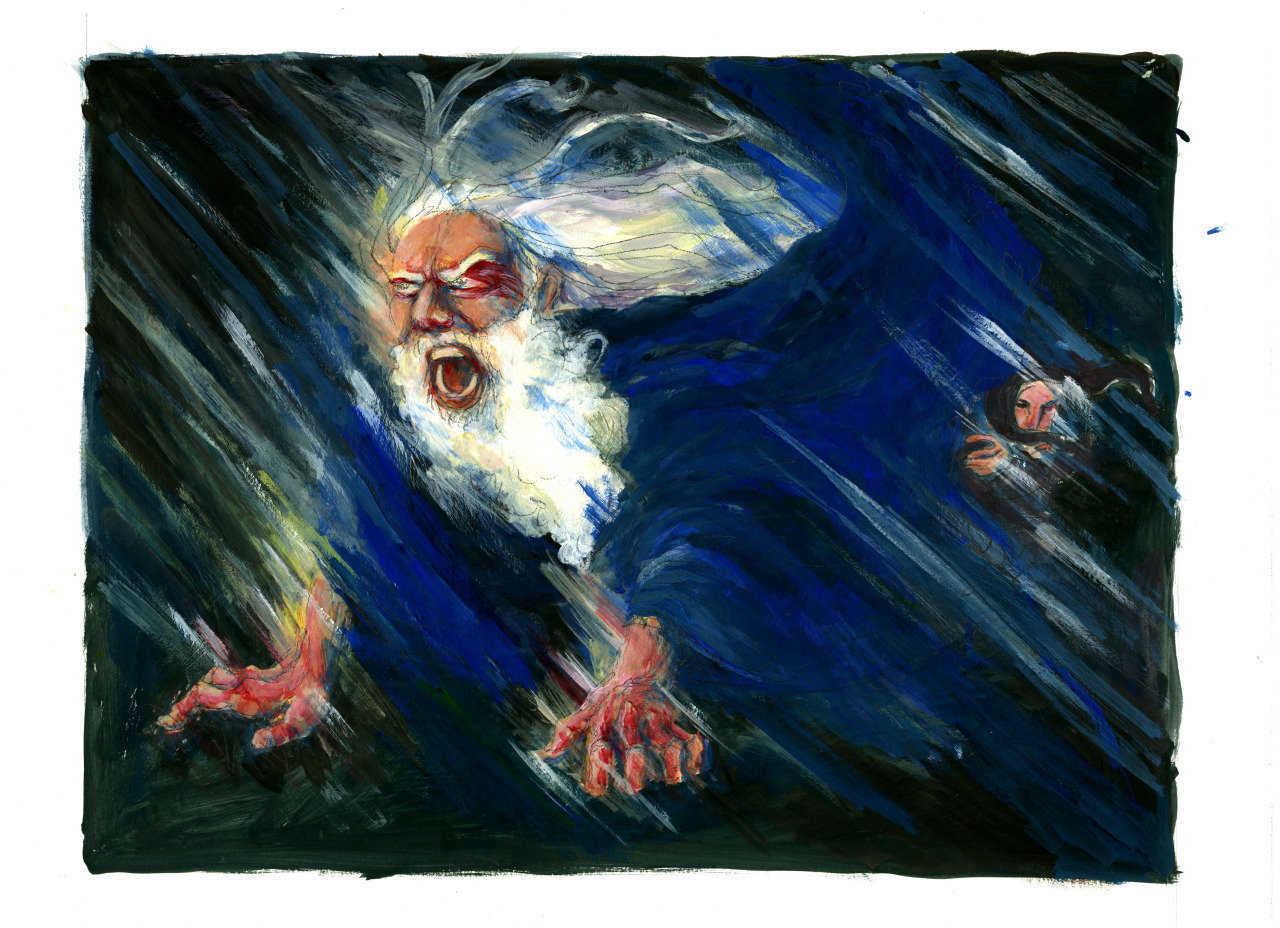
Lear in the Storm. Image from suziglass.tumblr.com

Lear in the Storm. Image from suziglass.tumblr.com

Buffeted by wind and rain, he realizes that royalty offers him no protection. Indeed, he is feeble and vulnerable:

“…here I stand, your slave,
A poor, infirm, weak, and despised old man.” III:2:19-20

A bit later, he decides that the storm is an agent sent by the gods to bring wrongdoers to repentance. He’s not quite ready to admit the extent of his own misdeeds, though:

“I am a man
More sinned against than sinning.” III:2:59-60

The storm rumbles on, eroding his defenses. When we recognize our mortality we often become humbler, less sure of our own importance. Recognizing that we ourselves have needs can make us more sensitive to the needs of others. A few lines later Lear turns to his Fool, who like him is barraged by the elements, and says,

“Poor Fool and knave, I have one part in my heart
That’s sorry yet for thee.” III:2:72-3

It’s the first time Lear shows compassion for anyone. A few scenes later, he ‘s tempted to feel sorry for himself:

In such a night
To shut me out! Pour on; I will endure.
In such a night as this! O Regan, Goneril!
Your old kind father, whose frank heart gave all…” III:4:17-20

But, uncharacteristically, he doesn’t stop only with his own misfortune. He thinks of all those who have no protection from the storm:

“Poor naked wretches, whereso’er you are,
That bide the pelting of this pitiless storm,
How shall your houseless heads and unfed sides,
Your loop’d and window’d raggedness, defend you
From seasons such as these? O, I have ta’en
Too little care of this!” III:4:28-33

He not only has sympathy for human need, he regrets his former indifference. As Lear shows more and more signs of mental instability–he refuses shelter, identifies an apparently mad wanderer as a philosopher, and stages a bizarre mock trial of his daughters–he is at the same time becoming increasingly aware of human suffering and developing greater concern for others. In the next act, Lear has apparently lost his senses–he’s adorned himself with wild flowers and rambles disconnectedly–yet is more perceptive and insightful than ever. For example, he seems to have realized the flattery he received when king was all false:

“…they are not men o’ their words: they told me I was every thing; ’tis a lie, I am not ague-proof.” IV:6:105,6

He also recognizes that wealth and glamour often hide corruption:

“Through tatter’d clothes small vices do appear;
Robes and furr’d gowns hide all. Plate sin with gold,
And the strong lance of justice hurtless breaks:
Arm it in rags, a pigmy’s straw does pierce it.” IV:6:166-169

Lear is gaining wisdom; despite his madness, he could now rule more justly than he did when in his right mind. His estimation of himself has plummeted (“I am a very foolish, fond old man” IV:7:60), and he no longer expects complete deference from others. In fact, he recognizes the need to apologize to those he has wronged, such as disinherited daughter Cordelia:

“You must bear with me: Pray you now, forget and forgive: I am old and foolish.” IV:7:84-5

Finally, he learns to love. Freud thought that love and work were the signs of maturity. When the play starts, Lear apparently has had some success in his work, but seems incapable of love. Yet, in the final act, his love for Cordelia seems to have replaced any concern he has for himself. He’ll even go to prison cheerfully if she can be with him. Alas, she is killed, and he howls his grief:

“Why should a dog, a horse, a rat, have life,
And thou no breath at all? Thou’lt come no more,
Never, never, never, never, never!” V:3:308-10

He dies of heartache. Before he dies, though, he has become a mature human being, one who knows his limits, who feels compassion for others, who sees himself accurately, and who loves. Would that the storms of life always have such effect on us!

Posted in Psyche | Tagged , , , , , , | Leave a comment

“45 Years” and Past Selves

I caught a showing of the movie 45 Years over the weekend.  A couple–Kate (Charlotte Rampling) and Geoff (Tom Courtenay)–are preparing to celebrate 45 years of marriage when a letter related to Geoff’s past threatens to derail their relationship. The letter informs him that  the body of Katya, his former girlfriend who fell into a glacier while they were hiking in the Alps, has been found.

Kate is puzzled. “I know I told you about my Katya,” offers Geoff. though his comment seems more an indication that he wants to be perceived as open than evidence that he actually had told her. And why the possessive–“my Katia”? Geoff muses about his fast-frozen ex, “How strange would that be. She looks like she did in 1962 and I look like this.” What a peculiar concern: that he doesn’t look as good as a 50 year-old corpse does.

Over the next few days, Kate notices subtle changes in Geoff: he’s playing different music, he picks up a book by Kierkegaard again, he starts smoking, he doesn’t want to attend a much-anticipated reunion of former co-workers. Other things he does are more clearly related to Katya, such as rummaging through the attic in the middle of the night to look for her picture. He gradually tells Kate more about that earlier relationship, and what she learns isn’t always reassuring. The camera follows Kate, and the viewer only knows as much as she does about Geoff’s reactions. It’s looking to her, and to us, that he once wanted to be with Katya and only considered Kate because Katya was dead. Perhaps it’s worse than that; perhaps all these years she has been no more than a stand-in for a ghost.

Poor Kate! She tries to be understanding, but the foundations of her life are crumbling. She laments to Geoff that they have so few photos of their life together, and it’s easy to read her thoughts: if he really wanted their relationship, he would have created more record of it. Her friend Lena gushes about the upcoming 45th anniversary party, predicting that Geoff will break down when he’s there because that’s what guys do when they realize how important their mate is to them. Kate sits stone-faced and miserable, the upcoming celebration looking more like an endurance test than a joyful occasion.

As an older adult myself, I empathize with Kate. How difficult it would be to suspect that something you had devoted your life to is hollow at its core! I empathize with Geoff, too. He is not so much trying to pull away from Kate as being pulled away by an interior force. It is almost as if, 50 years later, he is falling down the same crevasse that swallowed Katya. Had he been hiding a preoccupation with his ex-girlfriend all those years? If he had been, I think he would have been more defensive and less disoriented than he is after the letter arrives. Instead, I suspect that the letter awoke something slumbering in him. I wonder, what would it be like to have an episode that had been tucked into some mental closet years ago burst out again, threatening to wreck havoc with one’s life? Geoff may have deceived Kate by not having mentioned Katya, but it’s as likely as not that he was deceiving himself, too. He probably thought his feelings for Katya would slumber forever and was as surprised as Kate when they awoke.

At one point, Geoff tells Kate “It doesn’t seem like it was me who was there.” That could be an excuse, but might also be a description that many of us could give for something we did a long time ago that was different from our subsequent lives. I attended a meeting of the John Birch Society when was about 14; I can’t now understand how I ever could have done such a thing (well, it was under the influence of a teacher I admired, but still…).  More significantly, my first job after my professional training was teaching college. After four years, I left that job for psychological practice, thinking I would be back teaching before long. The years went by, and after a while I didn’t think much about teaching. It did eventually seem strange that I had written and delivered all those lectures. Then, shortly after I turned 50, teaching was something I was again interested in doing, and so I did, for a little over 10 years.

Maybe we all have alternative selves that we’ve filed away somewhere and give little thought to unless, as with Geoff, something reminds us that there is another us that used to walk the earth and do things we now wouldn’t think of doing. Without some prompting, that alternative self may never emerge. Or events may make it emerge so strongly that it competes with our present self for our allegiance. Geoff’s uncharacteristic behavior seems to be a manifestation of such an inner struggle. He apparently resolves that conflict by the end of the movie; go see the film if you’re curious about what happens to him.

Posted in Psyche, Relationships, Uncategorized | Tagged , , , , , , , | Leave a comment

The Old Fool: Lessons from King Lear

I recently wrote about the relationship between Shakespeare’s King Lear and his daughters. The behavior of Lear and his two eldest daughters demonstrate how family members shouldn’t treat one another. There’s much more to learn from King Lear than the problems that can occur between parents and adult children, though. For example, we learn a good deal about folly and wisdom. This post is mostly about the folly Lear shows in the first two acts. A subsequent post will examine how he acquires wisdom.

Though he is elderly, Lear initially is immature. He wants his daughters to fawn over him, becomes vindictive when youngest daughter Cordelia refuses to do so, and petulantly banishes the Earl of Kent when that loyal subject begs him to reconsider. Lear is apparently unaccustomed to anyone questioning him or even telling him the truth. In the absence of any sort of honest feedback, he is a man who thinks himself much different than how he is. In other words, Lear doesn’t know himself. This is evident in an interaction with his daughter Goneril. Goneril thinks him foolish (“Old fools are babes again….” Act I, Scene 3, Line 20) but to his face calls him wise in an effort to manipulate him:

“Come, sir,
I would you would make use of that good wisdom,
Whereof I know you are fraught; and put away
These dispositions, that of late transform you
From what you rightly are.” (I:4:225-229)

Lear’s response is odd in a way, yet appropriate for what Goneril is trying to do:

“Doth any here know me? This is not Lear:
Doth Lear walk thus? speak thus? Where are his eyes?
Either his notion weakens, his discernings
Are lethargied–Ha! waking? ’tis not so.
Who is it that can tell me who I am?” (I:4:232-236)

In other words, I’ve lost track of who I am and no one seems able (or willing) to tell me. If the only information I am told about myself is false, I’ll never know myself.

After Lear has given his kingdom to daughters Goneril and Regan, they oppose his wishes and seek to impose their will on him. Lear starts to regret that he banished Cordelia, yet he won’t take responsibility for his decision. Instead, he claims his behavior stemmed from some external force that mislead him:

O most small fault,
How ugly didst thou in Cordelia show!
That, like an engine, wrench’d my frame of nature
From the fix’d place; drew from heart all love,
And added to the gall. O Lear, Lear, Lear!
Beat at this gate, that let thy folly in [Striking his head]
And thy dear judgment out!  (I:4:273-279)

Lear views Goneril as the main source of his troubles, and curses her. His Fool sees much more clearly than him that Lear himself is responsible for what is happening:

“…for when thou gavest them the rod, and put’st down thine own breeches,
[Singing] Then they for sudden joy did weep,
And I for sorrow sung,
That such a king should play bo-peep,
And go the fools among.” (I:4:177-182)

Lear listens, but doesn’t learn. He goes to Regan, the other daughter who received a portion of his kingdom, but gets no better treatment from her. Lear eventually suspects that he lacks some quality he needs to deal with his daughters’ insurrection, but initially (and incorrectly) thinks that what he needs is determination fueled by anger:

“You heavens, give me that patience, patience I need!
You see me here, you gods, a poor old man,
As full of grief as age; wretched in both!
If it be you that stir these daughters’ hearts
Against their father, fool me not so much
To bear it tamely; touch me with noble anger,
And let not women’s weapons, water-drops,
Stain my man’s cheeks!” (II:4:270-277)

So Lear’s folly is that he doesn’t know himself, takes no responsibility for his faults, blames his hardships on others, and thinks angry confrontations will make life better. I’ve known some older adults who have pretty much the same set of characteristics. Usually, they are embroiled in tumultuous relationships and are themselves miserable. Is there any hope that such hardened personality dispositions will ever change?

Shakespeare must think so. At the end of Act II, Lear leaves in a rage, out to the heath, where a storm is brewing. He will come though the storm much wiser than he goes in. What happens to make him a different person? That will be a topic of another post.

"King Lear and the Fool in the Storm," by William Dyce

“King Lear and the Fool in the Storm,” by William Dyce

Posted in Psyche, Relationships | Tagged , , , , , | 2 Comments

Disrespectful Adult Children: Lessons from King Lear

In an earlier post I wrote about Shakespeare’s King Lear, looking at the king’s interactions with his daughters. Lear promised to distribute his kingdom to his daughters if they would profess great love for him. Goneril and Regan, the two oldest, responded by expressing incredible love. Cordelia, the youngest, said she loved Lear but wouldn’t attempt to outdo her sisters. Lear was enraged by her modest response and disinherited her. I pointed out that Lear loved conditionally rather than unconditionally and that he had arranged matters so as to encourage manipulation. I started to discuss the effects his behavior had on his daughters. In this post I’ll look more at how Goneril and Regan reacted to Lear.

Lear set a few conditions on his transfer of his kingdom, namely that Goneril and Regan allow him to retain 100 knights and agree to house him and his knights, each a month at a time. Lear first goes to the palace of Goneril and her husband, the Duke of Albany. Things quickly turn sour. Forgetting Lear’s gift to her, Goneril soon begins complaining about him:

By day and night he wrongs me; every hour
He flashes into one gross crime or other,
That sets us all at odds: I’ll not endure it:
His knights grow riotous, and himself upbraids us
On every trifle. (Act I: Scene 3: Lines 4-8)

It’s fascinating that Goneril then employs a metaphor for the elderly that still is heard today:

Idle old man,
That still would manage those authorities
That he hath given away! Now, by my life,
Old fools are babes again; and must be used
With cheques as flatteries,–when they are seen abused. (I:3:17-21)

In other words, old Lear is like a child that must be disciplined when he is wrong. As we age, we can indeed develop some childlike characteristics, such as indifference to social convention and an enhanced sense of wonder. Some of us may even become childlike in that we don’t always show good judgment. I’m constantly hearing of older adults with balance problems who fall because they were a little too confident that they could walk without using a cane or walker. That sort of questionable judgment is not the same as regressing to childhood, though. My mother is ninety; she occasionally does overestimate what she can do, but on the whole she displays considerable wisdom when it comes to understanding her limits and life’s complexities. She is no more like a child than she was fifty years ago.

Goneril proposes “A little to disquantity your train,” in other words, to cut the number of Lear’s knights by discharging those she considers unruly. Lear’s response is just a bit over the top, pleading with nature and the gods as follows:

Into her womb convey sterility!
Dry up in her the organs of increase;
And from her derogate body never spring
A babe to honour her! If she must teem,
Create her child of spleen; that it may live,
And be a thwart disnatured torment to her!
Let it stamp wrinkles in her brow of youth;
With cadent tears fret channels in her cheeks;
Turn all her mother’s pains and benefits
To laughter and contempt; that she may feel
How sharper than a serpent’s tooth it is
To have a thankless child! Away, away! (I:4:285-296)

In other words, I hope she is barren or has a child who treats her as badly as she treated me. Lear leaves to seek consolation from Regan, only to find that she both sides with Goneril and like her expresses doubts as to his mental capacity:

O, sir, you are old.
Nature in you stands on the very verge
Of her confine: you should be ruled and led
By some discretion, that discerns your state
Better than you yourself. Therefore, I pray you,
That to our sister you do make return;
Say you have wrong’d her, sir. (II:4:145-151).

Lear responds much more humbly than he did to Goneril:

‘Dear daughter, I confess that I am old;
Kneeling
Age is unnecessary: on my knees I beg
That you’ll vouchsafe me raiment, bed, and food.’ II:4:153-155)

Regan will have none of it, and insists he return to Goneril and apologize. Doing so would be so unpalatable that Lear decides to strike out on his own, though this means heading out into a dreadful storm. Lear had habitually shown imperiousness and inflexibility to his daughters. Now, when he responds reasonably, Regan is unbending, just as he taught her to be.

This is one of the lessons Shakespeare has for us. We reap what we sow. When Lear was in charge he wasn’t concerned with anyone’s welfare, even his daughters. After he relinquishes power, Goneril and Regan show the same disregard for his welfare as he previously showed to them. How we treated our children when they were dependent on us is an important factor (though not the only factor) influencing how they will treat us when we eventually need their help. Show kindness to your children; it’s good policy, both for them and, eventually, for us.

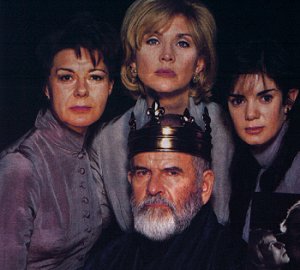
Lear and His Daughters (1997 BBC Production)

Lear and His Daughters (1997 BBC Production)

Posted in Relationships | Tagged , , , , , , , | Leave a comment