
The last thing I posted on this site was a reflection on turning 76. I wrote: “That somehow seems much older than 75. I’m not sure what the difference is. Maybe it’s that 80 looms closer, and that landmark seems not just old in a still-vibrant way but old-old.”
Six months on, my change in perspective has stuck, though I’m not as preoccupied with being old-old as I was at first. I think that being old-old is now a framework through which I filter experiences, and that has led to some new understandings. I’m going to write some about these, not so much to explain them to others but to better understand them myself.
In this post I’ll discuss how travel seems different to me. I really enjoy travelling, particularly international travel. I first traveled to Europe in 1999, and have crossed the Atlantic several times since then—Berlin and Prague in 2002, Budapest in 2003, a Mediterranean cruise in 2008, London in 2012, Israel in 2016, Turkey in 2018, and England in 2022. I embraced tourism, which the Britannica website defines as “the act and process of spending time away from home in pursuit of recreation, relaxation, and pleasure, while making use of the commercial provision of services.” In accord with the definition, I find travel pleasurable, though I think my main interest is not in the things Britannica lists but in gaining cultural and historical knowledge. Thus, in London you’re likely to find me at the British Museum or the National Gallery, not at Harrods or the London Eye. I’m interested in growth of the mind more than in having a good time. Besides valuing these historical and cultural elements, I gradually came to see travel as pilgrimage. I’ve visited sacred places and focused on my connection with God and on spiritual growth rather than on recreation, entertainment, or intellectual growth.
In September, I went on another international trip, to Amsterdam and Germany. For the Germany portion, I and my son Elliot were part of a group visiting the places where Luther and other Reformation figures studied, worked, and lived. Some of the trip was touristy—the Van Gogh Museum and a canal boat ride in Amsterdam, The Reichstag in Berlin and Neuschwanstein in the German Alps. Some sites I approached more as a pilgrim: Ould Kerk in Amsterdam, The Bonhoeffer House in Berlin, the Castle Church in Wittenberg, and the Theatinerkirche in Munich. These evoked something of the sacred or an appreciation of how God had been present in these places. As I age, the pilgrimage aspect of travel takes on greater importance to me.

Bonhoeffer House, Berlin, Germany
Besides sliding between tourism and pilgrimage, I think that travel evokes something else in me that wasn’t present, at least not as strongly, when traveling 20 years ago. There’s more of a sense of continuity with the past and a diminished emphasis on the present. We all mostly view the world from the time in which we live, from now. We have a preference for the present, and view times past as substantially different and probably inferior. Or, if we see some similarity between past and present, we ignore the substantial differences and assume that those living in earlier eras were thinking pretty much as we do. As I’ve aged, I’m less inclined to prefer the present and to reshape the past in conformity with the present.
One reason for the change is that much more of the past was once present for me than used to be the case. As a teenager or young adult, my remembered past was only a little over 10 years. Now, I can remember things that happened 70 years ago. Many early memories are of family events or places I lived, but I can remember more national and international history as well. I remember the television broadcast of the 1956 political party conventions, for example. I remember Sputnik and the Cuban revolution. When I was in Berlin on my recent trip, I certainly could remember when the Wall went up between East and West Berlin, and also could recall television images of the Berlin airlift. It turns out that the airlift ended when I was 16 months old, so the videos in my mind’s eye must have been broadcast later, but I still have a sense that the conflict over Berlin was something that happened in my lifetime. As such, it doesn’t seem particularly distant or unfamiliar to me. So it’s easy for me to sense continuity with that period.
My changed sense of history isn’t limited to the years within my span of life. I see similarities between my life and that of historical figures such as Luther, Lucas Cranach, Van Gogh, and Bonhoeffer despite the significant differences in how we each lived. The problems that Luther tried to solve (how to resist an ideology that seems to be exploiting human ignorance and need, how to handle sudden celebrity, how to respond to violent threats, how to rein in a movement that one no longer controls) all have present-day equivalents. The similarities seem more important than the dissimilar specifics—indulgences, papal authority, and Anabaptists. The dilemmas faced by those who lived hundreds of years ago are quite a bit like the dilemmas we face. I think I’m better at seeing our commonalities while still respecting the tremendous differences in such matters as culture and technology.
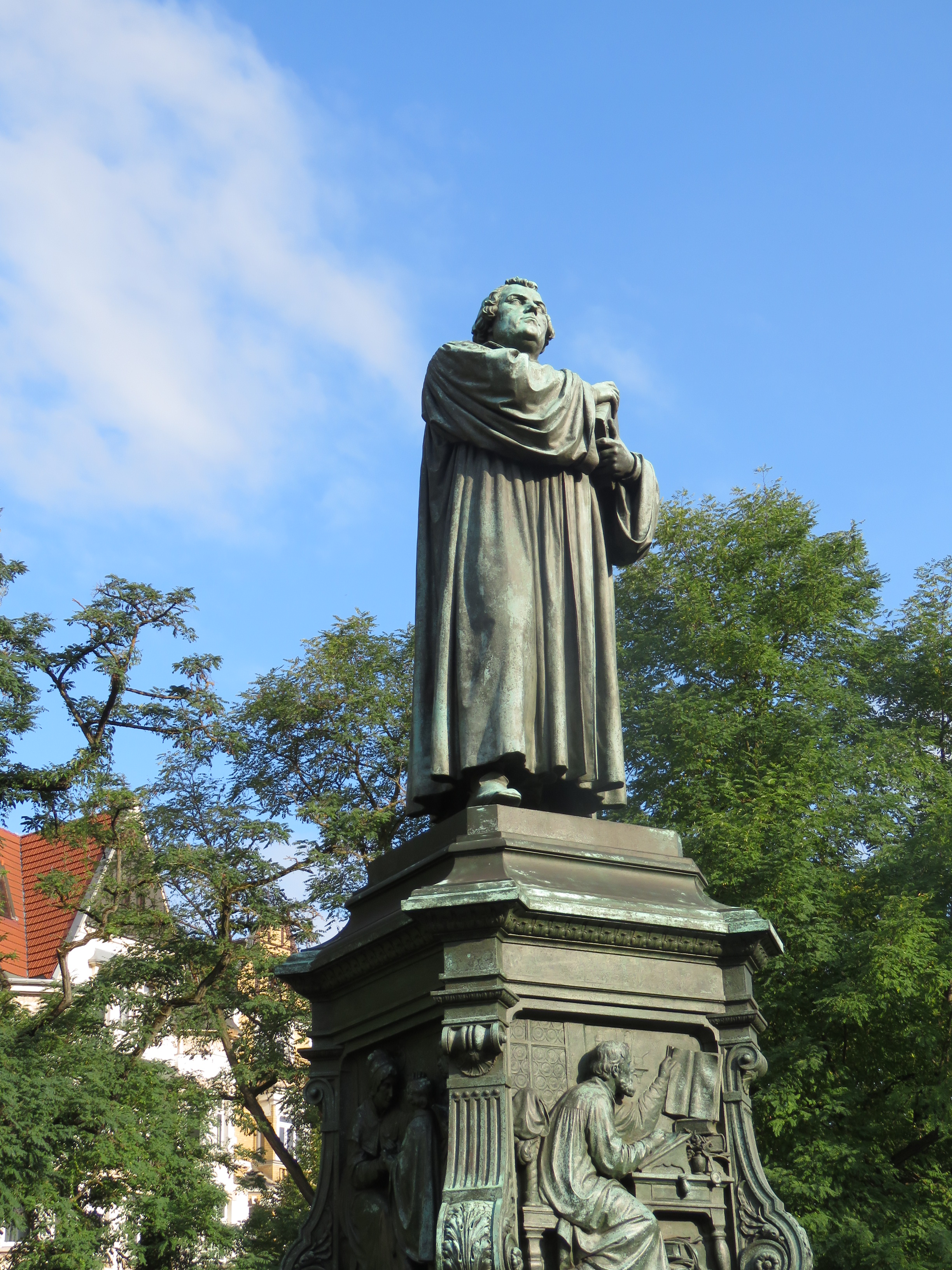
Statue of Luther, Eisenach, Germany
I’m not quite sure what mechanism connects growing older with such changes in perspective. There are many possibilities. Maybe it’s a matter of having much more knowledge of history than I used to. Maybe I don’t retain details as well, so broad strokes are more salient. Maybe I’m thinking more of ending up where forbearers did—in the grave. Whatever the reason, the change does make reading history and visiting historical sites more meaningful and pertinent to my life. I’m thankful for that. And I hope to keep traveling!

 Beyond Halfway
Thank you for sharing this beautifully written perspective of “Travelling while old-old”. I look forward to seeing you soon. I also love to travel, and have two significant trips scheduled for this year so far, which I will tell you about soon when you visit us.
Would love to hear about your trips past and future. Look forward to seeing you soon!